MCQ
Among the following complexes the one which shows zero crystal field stabilization energy $(CFSE)$ is
- A$[Mn(H_2O)_6]^{3+}$
- ✓$[Fe(H_2O)_6]^{3+}$
- C$[Co(H_2O)_6]^{2+}$
- D$[Co(H_2O)_6]^{3+}$
$\Delta_{o}<$ pairing energy.
$\mathrm{CFSE}=(-0.4 x+0.6 y) \Delta_{o}$
where, $x$ and $y$ are no. of electrons occupying $t_{2 g}$ and es orbitals respectively.
For $\left[\mathrm{Fe}\left(\mathrm{H}_{2} \mathrm{O}\right)_{6}\right]^{3+}$ complex ion.
$\mathrm{Fe}^{3+}\left(3 d^{5}\right) =t_{2 \mathrm{g}}^{3} e_{\mathrm{g}}^{2}=-0.4 \times 3+0.6 \times 2$
$=0.0 \text { or } 0\; \mathrm{Dq}$
Generate a complete, print-ready paper with questions like this in minutes — across 16+ boards, with answer keys.
$\Delta_f G^0[\mathrm{C}(\text { graphite })]=0 \mathrm{kJmol}^{-1}$
$\Delta_f G^0[\mathrm{C}(\text { diamond })]=2.9 \mathrm{kJmol}^{-1}$
The standard state means that the pressure should be $1$ bar, and substance should be pure at a given temperature. The conversion of graphite [C(graphite)] to diamond [C(diamond)] reduces its volume by $2 \times 10^{-6} \mathrm{~m}^3 \mathrm{~mol}^{-1}$. If $\mathrm{C}$ (graphite) is converted to $\mathrm{C}$ (diamond) isothermally at $\mathrm{T}=298 \mathrm{~K}$, the pressure at which $C$ (graphite) is in equilibrium with C(diamond), is
[Useful information: $1 \mathrm{~J}=1 \mathrm{~kg} \mathrm{~m}^2 \mathrm{~s}^{-2} ; 1 \mathrm{~Pa}=1 \mathrm{~kg} \mathrm{~m}^{-1} \mathrm{~s}^{-2} ; 1 \mathrm{bar}=10^5 \mathrm{~Pa}$ ]
$(A)$ $T$ is soluble in hot aqueous $NaOH$
$(B)$ $U$ is optically active
$(C)$ Molecular formula of $W$ is $C _{10} H _{18} O _4$
$(D)$ $V$ gives effervescence on treatment with aqueous $NaHCO _3$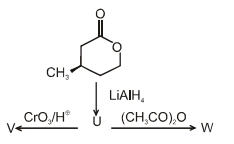
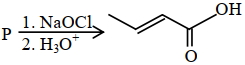
$\begin{array}{|l|l|} \hline \,\,List\,\,\,\,I\,\,(Compound) & \,\,List\,\,II\,\,(Oxidation\,\,state\,\,of\,\,N) \\ \hline (A)\,\,N{{O}_{2}} & (1)\,\,\,\,+\,\,5 \\ \hline (B)\,\,HNO & (2)\,\,-\,\,3 \\ \hline (C)\,\,N{{H}_{3}} & (3)\,\,+\,\,4 \\ \hline (D)\,\,{{N}_{2}}{{O}_{5}} & (4)\,\,+\,\,1 \\ \hline \end{array}$
code : $A \,\, B \,\,C \,\,D$