MCQ
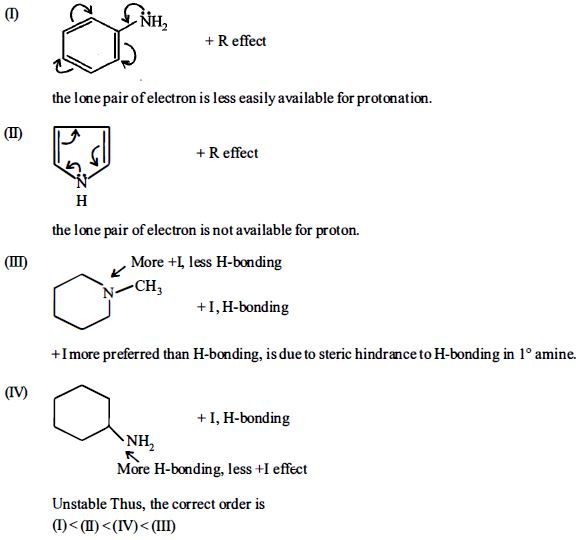
Among the following compounds, the increasing order of their basic strength is
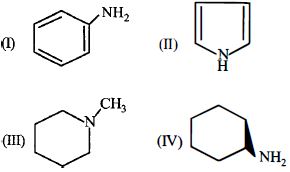
- ✓$(I) < (II) < (IV) < (III)$
- B$(I) < (II) < (III) < (IV)$
- C$(II) < (I) < (IV) < (III)$
- D$(II) < (I) < (III) < (IV)$
Generate a complete, print-ready paper with questions like this in minutes — across 16+ boards, with answer keys.
$1.$ Among the following, the correct statement is
$(A)$ Phosphates have no biological significance in humans
$(B)$ Between nitrates and phosphates, phosphates are less abundant in earth's crust
$(C)$ Between nitrates and phosphates, nitrates are less abundant in earth's crust
$(D)$ Oxidation of nitrates is possible in soil
$2.$ Among the following, the correct statement is
$(A)$ Between $\mathrm{NH}_3$ and $\mathrm{PH}_3, \mathrm{NH}_3$ is better electron donor because the lone pair of electrons occupies spherical ' $\mathrm{s}$ ' orbital and is less directional
$(B)$ Between $\mathrm{NH}_5$ and $\mathrm{PH}_5, \mathrm{PH}_5$ is better electron donor because the lone pair of electrons occupies $\mathrm{sp}^3$ orbital and is more directional
$(C)$ Between $\mathrm{NH}_3$ and $\mathrm{PH}_3, \mathrm{NH}_3$ is a better electron donor because the lone pair of electrons occupies $\mathrm{sp}^3$ orbital and is more directional
$(D)$ Between $\mathrm{NH}_3$ and $\mathrm{PH}_3, \mathrm{PH}_3$ is better electron donor because the lone pair of electrons occupies spherical ' $\mathrm{s}$ ' orbital and is less directional
$3.$ White phosphorus on reaction with $\mathrm{NaOH}$ gives $\mathrm{PH}_3$ as one of the products. This is a
$(A)$ dimerization reaction
$(B)$ disproportionation reaction
$(C)$ condensation reaction
$(D)$ precipitation reaction
Give the answer question $1,2$ and $3.$
$\begin{array}{*{20}{c}}
{Cl\,\,\,\,} \\
{|\,\,\,\,\,\,\,\,} \\
{C{H_3} - CH - COOH}
\end{array}\mathop {\xrightarrow{{(i)\,N{H_3}}}}\limits_{1\,mole\,\,(ii)\,{H_2}O} [X]$
Product $[X]$ will be :
Reason : Oxidation takes place at anode and reduction at cathode.