MCQ
Among the following halogens $F_2, Cl_2, Br_2$ and $I_2$ Which can undergo disproportionation reaction?
  • A
    Only I2
  • B
    Cl2, Br2 and I2
  • C
    F2, Cl2 and Br2
  • D
    F2 and Cl2

Answer

$F_2$ do not disproportionate because fluorine do not exist in positive oxidation state however $Cl_2, Br_2, I_2$ undergoes disproportionation.

Need a full question paper?

Generate a complete, print-ready paper with questions like this in minutes — across 16+ boards, with answer keys.
Start Generating Free

Similar questions

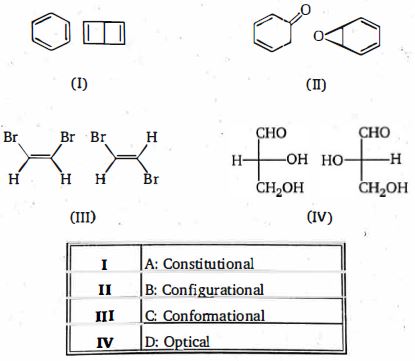
The relationship among the following pairs of isomers is
$(i)\,Al\,\xrightarrow{{{N_2}}}\,A$         $(ii)\,Al\,\xrightarrow{c}\,B$

Here $A$ and $B$ on hydrolysis respectively gives

Calculate the heat of formation of $PC{l_5}(s)$ from the following data

$2P(s) + 3C{l_2}(g)\,\, \to \,\,2PC{l_3}(l);\,\Delta H = - 151.8\,kcal$

$PC{l_3}(l) + C{l_2}(g)\,\, \to \,\,PC{l_5}(s);\,\,\Delta H = - 32.8\,kcal$

......$kcal$
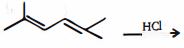
What is the product of $1, 4$ -addition in the reaction shown below ?
${C_2}{H_6}_{(g)} + n{O_2}\, \to \,C{O_2}\,_{(g)} + {H_2}O\,_{(l)}$ In this equation, the ratio of the coefficients of $C{O_2}$ and ${H_2}O$ is
The bond order and magnetic property of acetylide ion are same as that of $........$.
For preparing monoalkyl benzene, acylation process is preferred than direct alkylation because
When $Br_2$ is treated with aqueous solutions of $NaF,\, NaCl$ and $NaI$ separately
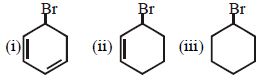
Compare rate of reaction with $AgNO_3$
The conductance of a $0.0015 \mathrm{M}$ aqueous solution of a weak monobasic acid was determined by using a conductivity cell consisting of platinized $\mathrm{Pt}$ electrodes. The distance between the electrodes is $120 \mathrm{~cm}$ with an area of cross section of $1 \mathrm{~cm}^2$. The conductance of this solution was found to be $5 \times 10^{-7} \mathrm{~S}$. The $\mathrm{pH}$ of the solution is $4$ . The value of limiting molar conductivity $\left(\Lambda_{\mathrm{m}}^0\right)$ of this weak monobasic acid in aqueous solution is $\mathrm{Z} \times 10^2 \mathrm{~S} \mathrm{~cm}^{-1} \mathrm{~mol}^{-1}$. The value of $\mathrm{Z}$ is