MCQ
Among the following ions which one has the highest paramagnetism
- A$[Cr(H_2O)_6]^{3+}$
- ✓$[Fe(H_2O)_6]^{2+}$
- C$[Cu(H_2O)_6]^{2+}$
- D$[Zn((H_2O)_6]^{2+}$
The oxidation number of $Cr$ is $+3$
Atomic number $=24$
$Cr =[ Ar ] 3 d ^5 4 s ^1$
$Cr ^{3+}=[ Ar ] 3 d ^3 4 s ^0$
There are three unpaired electrons.
$\left[ Fe \left( H _2 O \right)_6\right]^{2+}$
The oxidation number of $Fe$ is $+2$.
Atomic number $=26$
$Fe =[ Ar ] 3 d ^6 4 s ^2$
$Fe ^{2+}=[ Ar ] 3 d ^6 4 s ^0$
There are four unpaired electrons
$\left[ Cu \left( H _2 O \right)_6\right]^{2+}$
The oxidation number of $Cu$ is $+2$.
Atomic number $=29$
$Cu =[ Ar ] 3 d ^{10} 4 s ^1$
$Cu ^{2+}=[ Ar ] 3 d ^9 4 s ^0$
There is one unpaired electron.
$\left[ Zn \left( H _2 O \right)_6\right]^{2+}$
The oxidation number of $Zn$ is $+2$.
Atomic number $=30$
$Zn =[ Ar ] 3 d ^{10} 4 s ^2$
$Zn ^{2+}=[ Ar ] 3 d ^{10} 4 s ^0$
There are no unpaired electrons.
$\left[ Fe \left( H _2 O \right)_6\right]^{2+}$ has the maximum number of unpaired electrons; therefore, the highest degree of paramagnetism.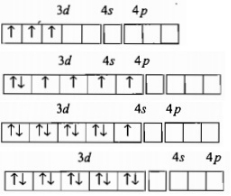
Generate a complete, print-ready paper with questions like this in minutes — across 16+ boards, with answer keys.
$MnO_2+ 4HCl \to MnCl_2 + 2H_2O + Cl_2$
If molar mass of hydrochloric acid is $M$.
| $List-I$ (Compound) | $List-II$ (Shape) |
| $(A)$ $BrF _{5}$ | $(I)$ bent |
| $(B)$ $\left[ CrF _{6}\right]^{3-}$ | $(II)$ square pyramidal |
| $(C)$ $O _{3}$ | $(III)$ trigonal bipyramidal |
| $(D)$ $PCl _{5}$ | $(IV)$ octahedral |
Choose the correct answer from the options given below.