MCQ
Among the following ions which one has the highest paramagnetism
- A$[Cr(H_2O)_6]^{3+}$
- ✓$[Fe(H_2O)_6]^{2+}$
- C$[Cu(H_2O)_6]^{2+}$
- D$[Zn((H_2O)_6]^{2+}$
The oxidation number of $Cr$ is $+3$
Atomic number $=24$
$Cr =[ Ar ] 3 d ^5 4 s ^1$
$Cr ^{3+}=[ Ar ] 3 d ^3 4 s ^0$
There are three unpaired electrons.
$\left[ Fe \left( H _2 O \right)_6\right]^{2+}$
The oxidation number of $Fe$ is $+2$.
Atomic number $=26$
$Fe =[ Ar ] 3 d ^6 4 s ^2$
$Fe ^{2+}=[ Ar ] 3 d ^6 4 s ^0$
There are four unpaired electrons
$\left[ Cu \left( H _2 O \right)_6\right]^{2+}$
The oxidation number of $Cu$ is $+2$.
Atomic number $=29$
$Cu =[ Ar ] 3 d ^{10} 4 s ^1$
$Cu ^{2+}=[ Ar ] 3 d ^9 4 s ^0$
There is one unpaired electron.
$\left[ Zn \left( H _2 O \right)_6\right]^{2+}$
The oxidation number of $Zn$ is $+2$.
Atomic number $=30$
$Zn =[ Ar ] 3 d ^{10} 4 s ^2$
$Zn ^{2+}=[ Ar ] 3 d ^{10} 4 s ^0$
There are no unpaired electrons.
$\left[ Fe \left( H _2 O \right)_6\right]^{2+}$ has the maximum number of unpaired electrons; therefore, the highest degree of paramagnetism.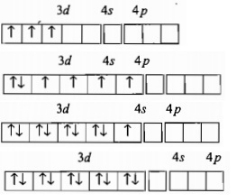
Generate a complete, print-ready paper with questions like this in minutes — across 16+ boards, with answer keys.
(Image)
$x=$.. . . . . .(nearest integer)
[Given: Molal freezing point depression constant of water at $273.15 \mathrm{~K}^2$ is $1.86 \mathrm{~K} \mathrm{~kg} \mathrm{~mol}^{-1}$ ]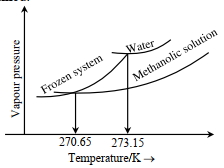
(image) $\xrightarrow{{HOH/\mathop H\limits^ \oplus }}$ $[X]$
$[X]$ will be :
($1$) The value of $x$ is. . . . .
($2$) The value of $y$ is. . . . .