MCQ
Among the following species, the least angle around the central atom is in
- A$O_3$
- B$I^-_3$
- C$NO^-_2$
- ✓$PH_3$
$(B) \,I_3^-$ undergoes $sp^3 d$ hybridisation and linear shape so its bond angle is $180^{\circ}$.
$(C) \,NO _2^{-}$ undergoes $s p^2$ hybridisation and So, its bond angle is nearly $120^{\circ}$
$(D) \,PH _3$ undergoes $sp ^3$ hybridisation and contains one lone pair, so its bond angle is mearly $90^{\circ}$
$\therefore$ Among all the options, $PH _3$ has least angle around the central atom.
Generate a complete, print-ready paper with questions like this in minutes — across 16+ boards, with answer keys.
$(i)$ $1s^22s^2p^63s^1$ $(ii)$ $1s^22s^22p^64s^1$
Which of the following statements is/are false ?
$(a)$ Energy is required to change $(i)$ to $(ii)$
$(b)$ $(i)$ represents $‘Na’$ atom
$(c)$ $(i)$ and $(ii)$ represent different elements
$(d)$ More energy is required to remove one electron from $(i)$ than $(ii)$
$A$. $T _4 > T _3 > T _2 > T _1$
$B.$ The black body consists of particles performing simple harmonic motion.
$C.$ The peak of the spectrum shifts to shorter wavelength as temperature increases.
$D.$ $\frac{ T _1}{ v _1}=\frac{ T _2}{ v _2}=\frac{ T _3}{ v _3} \neq$ constant
$E.$ The given spectrum could be explained using quantisation of energy.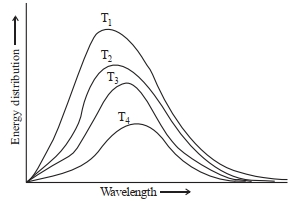
$(a)$ $CO < C{O_2} < CO_3^{2 - }$ $ \Rightarrow $ Bond length
$(b)$ ${O_2} < {O_3} < O_2^{ - 2}$ $ \Rightarrow $ Bond length
$(c)$ ${N_2} < N_2^ + $ $ \Rightarrow $ Bond energy