MCQ
Among the following, the species having square planar geometry for central atom are
$(i)$ $XeF_4$           $(ii)$ $SF_4$
$(iii)$ $[NiCl_4]^{2-}$           $(iv)$ $[PtCl_4]^{2-}$
  • $(i)$ and $(iv)$
  • B
    $(i)$ and $(ii)$
  • C
    $(ii)$ and $(iii)$
  • D
    $(iii)$ and $(iv)$

Answer

Correct option: A.
$(i)$ and $(iv)$
a
Square Planar Structure : $XeF_4$ and $[PtCl_4]^{2-}$

Need a full question paper?

Generate a complete, print-ready paper with questions like this in minutes — across 16+ boards, with answer keys.

Start Generating Free

Similar questions

$0.1$ $mole$ of ${N_2}{O_{4(g)}}$ was sealed in a tube under one atmospheric conditions at $25\,^oC$. Calculate the number of moles of $N{O_{2(g)}}$ present, if the equilibrium ${N_2}{O_{4(g)}}$ $\rightleftharpoons$ $2N{O_{2(g)}}$ $({K_p} = 0.14)$ is reached after some time
If a system is at equilibrium the rate of forward to the reverse reaction is
Number of $\sigma-$bonds and $\pi-$bonds present in
is:
The metal which gives $H_2$ with dil acid as well as $\ce{NaOH}$ is.
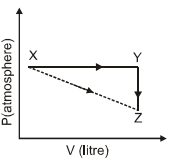
For an ideal gas, consider only $P - V$ work in going from an initial state $X$ to the final stat $Z$. The final state $Z$ can be reached by either of the two paths shown in the figure. Which of the following choice$(s)$ is (are) correct? [take $\Delta S$ as change in entropy and w as work done].

$(A)$ $\Delta S _{ x \rightarrow z}=\Delta S _{ x \rightarrow y}+\Delta S _{ y \rightarrow z}$

$(B)$ $w_{x \rightarrow z}=w_{x \rightarrow y}+w_{y \rightarrow z}$

$(C)$ $w_{x \rightarrow z \rightarrow z}=w_{x \rightarrow y}$

$(D)$ $\Delta S _{x \rightarrow y \rightarrow z}=\Delta S _{x \rightarrow y}$

Which of them are Non $-$ biodegradable waste?
Molecule having maximum number of lone pairs of electrons on central atom is :
Graphite conducts electricity due to the:
The de Broglie wavelength $\left( \lambda  \right)$ associated with a photoelectron varies with the frequency $(v)$ of the incident radiation as, [$v_0$ is threshold frequency]:
Predict stereochemistry of product when $d$ and $l$ -amine reacts with $l$-acid