MCQ
Among the following the strongest nucleophile is
  • ${C_2}{H_5}SH$
  • B
    $C{H_3}CO{O^ - }$
  • C
    $C{H_3}N{H_2}$
  • D
    $NCCH_2^ - $

Answer

Correct option: A.
${C_2}{H_5}SH$
a
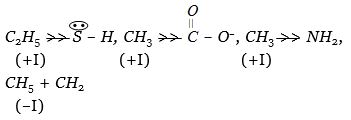
(a) Nucleophiles are those substances which can donate a pair of electrons. These can be neutral or negative. The nucleophilic power depends on the tendency of species to donate electrons. This is more, when an electron pushing group ($+I$ group) is present. Among the alkyl groups, those having higher number of $C$ - atoms will push more, hence ethyl $> $ methyl.
 

Need a full question paper?

Generate a complete, print-ready paper with questions like this in minutes — across 16+ boards, with answer keys.

Start Generating Free

Similar questions

Which of the following is liquid at room temperature
When $CH_3-CH_2-COOH$ is reduced with $LiAlH_4$, the compound obtained will be
For the given reaction, which is not used to change the colour ?

${K_2}Cr_2{O_7}/{H^ + } + y \to \mathop {C{r^{ + 3}} + Others}\limits_{(green)\,\,\,\,\,\,\,\,\,\,\,\,\,\,\,\,\,\,\,\,\,\,\,\,\,\,\,\,\,\,\,\,\,\,\,\,} $

The water soluble protein is :
Two oxides of nitrogen, $NO$ and $NO_2$ are allowed to react together at $243\,^o K$ and form a coloured compound of nitrogen $(X)$ . When compound $(X)$ reacts with water to yield another compound of nitrogen $(Y)$. The shape of the anion of $(Y)$ molecule is
The main product of following raction will be
Beryllium’s fourth electron will have the four quantum numbers :
Calculate  $\Delta H_f^o$ of $SiH_2$  from the following reactions

$Si_2H_6(g)\,\,+\,\,H_2(g)\,\,\to \,\, 2SiH_4(g),\,\,\Delta H\,\,=\,\,-\,11.7\,\,kJ/mol$

$SiH_4(g)\,\,\to \,\,SiH_2(g)\,\,+\,\,H_2(g),\,\, \Delta H\,\,=\,\,+239.7\,\,kJ/mol$

$\Delta H_f^o\,\,Si_2H_6(g)\,\,=\,\,80.3\,\,kJ/mol$

......$kJ/mol$

At certain temperature $(T)$ if conductivity of pure water is $5.5 × 10^{-7}\ Scm^{-1}$, then calculate $pH$ of water at given temp. Given :$\lambda _{{H^ + }}^\infty = 350\ S\,cm^2 \,eq^{-1}$

$\lambda _{O{H^ - }}^\infty$ $=200\, \ S\,cm^2 \,eq^{-1}$

Reduction of the metal centre in aqueous permanganate ion involves

$(A)$ $3$ electrons in neutral medium

$(B)$ $5$ electrons in neutral medium

$(C)$ $3$ electrons in alkaline medium

$(D)$ $5$ electrons in acidic medium