MCQ
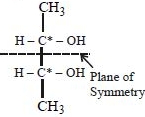
Among the following which one can have a meso form?
- A$CH_3CH(OH)CH(Cl)C_2H_5$
- ✓$CH_3CH(OH)CH(OH)CH_3$
- C$C_2H_5CH(OH)CH(OH)CH_3$
- D$HOCH_2CH(Cl)CH_3$
Generate a complete, print-ready paper with questions like this in minutes — across 16+ boards, with answer keys.

$ \mathrm{CH}_3-\mathrm{CH}_2-\mathrm{CH}\left(\mathrm{NO}_2\right)-\mathrm{COOH} $
$ \mathrm{CH}_3-\mathrm{CH}_2-\mathrm{CHBr}-\mathrm{CH}_2-\mathrm{CH}_3 $
$ \mathrm{CH}_3-\mathrm{CH}(\mathrm{I})-\mathrm{CH}_2-\mathrm{NO}_2 $
$ \mathrm{CH}_3-\mathrm{CH}_2-\mathrm{CH}(\mathrm{OH})-\mathrm{CH}_2 \mathrm{OH} $
$ \mathrm{CH}_3-\mathrm{CH}-\mathrm{CH}(\mathrm{I})-\mathrm{C}_2 \mathrm{H}_5 $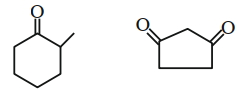
$H _2 O ( g ) \rightarrow H _2( g )+\frac{1}{2} O _2( g )$
The percent of water decomposing at $2300\,K$ and $1\,bar$ is $...........$ (Nearest integer).
Equilibrium constant for the reaction is $2 \times 10^{-3}$ at $2300\,K$
Statement $I$ : Boron is extremely hard indicating its high lattice energy
Statement $II$ : Boron has highest melting and boiling point compared to its other group members.
In the light of the above statements, choose the most appropriate answer from the options given below