MCQ
Among the given compounds, the correct dehydration order is :
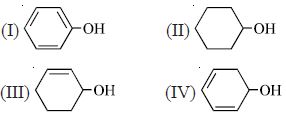
  • $I < II < III < IV$
  • B
    $II < III < IV < I$
  • C
    $I < III < IV < II$
  • D
    $I < II < III = IV$

Answer

Correct option: A.
$I < II < III < IV$
a
Dehydration order is according to the stability of their intermediate. Benzylic carbocation is most stable due to resonance so $IV$ has the highest order. As allylic carbocation are more stable than $2^{\circ}$ carbocation, so the order is $III\, >\, II$.

Phenyl carbocations are least stable, so the order is $I\, <\, II\, < \,III \,<\, IV$.

Need a full question paper?

Generate a complete, print-ready paper with questions like this in minutes — across 16+ boards, with answer keys.

Start Generating Free

Similar questions

Diatoms, microscopic organisms, are an abundant food source in the oceans producing carbohydrates from carbon dioxide and water by photosynthesis

$6CO_2 + 6H_2O + solar energy \to C_6H_{12}O_6+6O_2$

A blue whales gain $75\ kg$ of mass per day by feeding on krill. The whale must consume ten times this mass of krill each day. The krill must consume $10.0\ kg$ of diatoms to produce $1.0\ kg$ of krill. Assuming that the mass gain of a whale's life is due to the consumption of carbohydrates $(C_6H_{12}O_6)$ , calculate the moles of $CO_2$ that must be used by the diatoms to produce the carbohydrates consumed by a blue whale in a day

In Duma's method of estimation of nitrogen, $0.1840 \,g$ of an organic compound gave $30 \,mL$ of nitrogen collected at $287\, K$ and $758\, mm$ of $Hg$ pressure. The percentage composition of nitrogen in the compound is ...... . (Round off to the Nearest Integer). [Given : Aqueous tension at $287\, K =14 \,mm$ of $Hg$ ]
What is the change in the energy of system if $500\text{ cal}$ of heat energy are added to a system and system does $350 \text{ cal}$ of work on the surroundings?
Fluoride ion is isoelectronic with
The reaction of calcium with water is represented by the equation $Ca + 2H_2O \to  Ca(OH)_2 + H_2$ What volume of $H_2$ at $STP$ would be liberated when $8\, gm$ of calcium completely reacts with water? .......... $\mathrm{cm}^{-3}$
Which of the following is not affected by change in pressure?
One mole of an ideal gas is allowed to expand reversibly and adiabatically from a  temperature of $27\,^oC$. If the work done during the process is $3\, kJ$, then final  temperature of  the gas is $(C_v = 20\, J/K)$ .....$K$
Electromagnetic radiatiations of frequency $‘ \nu ’$ consists of a stream of particles called photons. Which of the following statements is / are true about photons :
The number of moles of $\mathrm{CuO}$, that will be utilized in Dumas method for estimation nitrogen in a sample of $57.5 \,\mathrm{~g}$ of $\mathrm{N}, \mathrm{N}$-dimethylaminopentane is $.....\,\times 10^{-2} .$ (Nearest integer)
The number of electrons that are paired in oxygen molecule is