MCQ
Among the given compounds, the correct dehydration order is :
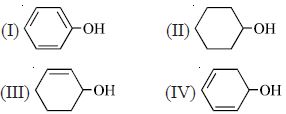
  • $I < II < III < IV$
  • B
    $II < III < IV < I$
  • C
    $I < III < IV < II$
  • D
    $I < II < III = IV$

Answer

Correct option: A.
$I < II < III < IV$
a
Dehydration order is according to the stability of their intermediate. Benzylic carbocation is most stable due to resonance so $IV$ has the highest order. As allylic carbocation are more stable than $2^{\circ}$ carbocation, so the order is $III\, >\, II$.

Phenyl carbocations are least stable, so the order is $I\, <\, II\, < \,III \,<\, IV$.

Need a full question paper?

Generate a complete, print-ready paper with questions like this in minutes — across 16+ boards, with answer keys.

Start Generating Free

Similar questions

Homolyte fission leads to formation of:
Nitration of toluene takes place at
The region in the electromagnetic spectrum where the Balmer series lines appear is
For the reversible reaction, ${N_{2(g)}} + 3{H_{2(g)}}$ $\rightleftharpoons$ $2N{H_{3(g)}}$ at $500\,^oC$, the value of ${K_P}$ is $1.44 \times {10^{ - 5}}$ when partial pressure is measured in atmospheres. The corresponding value of ${K_c}$ with concentration in mole litre$^{-1}$, is
The number of radial nodes of $3s$ and $2p$ orbitals are respectively
......$L$ litres of water must be added to $1\, litre$ an aqueous solution of $HCl$ with a $pH$ of $1$ to create an aqueous solution with $pH$ of $2$ ?
The enthalpy change for the conversion of $\frac{1}{2} Cl _2$ (g) to $Cl ^{-}$(aq) is $(-).......$

$kJ\,mol ^{-1}$ (Nearest integer)

Given : $\Delta_{ dis } H _{ Cl _{2(g)}}^{\circ}=240\,kJ\,mol ^{-1}$.

$\Delta_{ eg } H _{ Cl _{(g)}}^{\circ}=-350\,kJ\,mol ^{-1}$,

$\Delta_{ hyd } H _{ Cl i _{( j )}^{\circ}}^{\circ}=-380\,kJ\,mol ^{-1}$

$IUPAC$ name of the compound $\mathop C\limits^4 {H_2} = \mathop C\limits^3 H - \mathop C\limits^2 {H_2} - \mathop C\limits^1 {H_2}OH$ is
The volume of a gas decreases from $500\,cc$ to $300\,cc$ when a sample of gas is compressed by an average pressure of $0.6 \,atm. $ During this process $10 \,J $ of heat is liberated. The change in internal energy is......$J$
The potential energy of an electron in the hydrogen atom is $-6.8\,\,eV$. Indicate in which excited state, the electron is present