MCQ
Among the given ketones, the one which does not enolize is
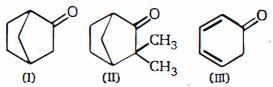
  • A
    $I$
  • $II$
  • C
    $III$
  • D
    none of these

Answer

Correct option: B.
$II$
b
unstable enol due to Bredt's rule.

Need a full question paper?

Generate a complete, print-ready paper with questions like this in minutes — across 16+ boards, with answer keys.

Start Generating Free

Similar questions

The maximum covalency of a non-metallic group 15 element 'E' with weakest $E - E$ bond is :
What is the correct mode of hybridization of the central atom in the following compounds : $NO_2^ + ,S{F_{4,}}P{F_6}^ - $
Copper reduces $NO _{3}^{-}$ into $NO$ and $NO _{2}$ depending uponthe concentration of $HNO _{3}$ insolution. (Assuming fixed $\left[ Cu ^{2+}\right]$ and $\left. P _{ NO }= P _{ NO _{2}}\right),$ the $HNO _{3}$ concentration at which the thermodynamic tendency for reduction of $NO _{3}^{-}$ into $NO$ and $NO _{2}$ by copper is same is $10^{ x }\, M$. The value of $2 x$ is ...... .

$\left[\right.$ Given $, E_{C u^{2+} / C u}^{o}=0.34\, V , E _{ NO _{3}^{-} / NO_2 }^{\circ}=0.96\, V$ (Rounded-off to the nearest integer) $E _{ NO _{3} / NO _{2}}^{\circ}=0.79 \,V$ and at $298 \,K$  $\left.\frac{ RT }{ F }(2.303)=0.059\right]$

The colour of tetrammine copper $ (II) $ sulphate is
Product $(A)$ of the reaction is
The size of nucleus is of the order of
Calculate the millimoles of $SeO_3^{2-}$ in solution on the basis of following data : $70\,ml$ of $\frac{M}{60}$ solution of $KBrO_3$ was added to $SeO_3^{2-}$ solution. The bromine evolved was removed by boiling and excess of $KBrO_3$ was back titrated with $12.5\, mL$ of $\frac{M}{25}$ solution of $NaAsO_2$. The reactions are given below.

$I.\,SeO_3^{2 - } + BrO_3^ -  + {H^ + } \to SeO_4^{2 - } + B{r_2} + {H_2}O$

$II.\,BrO_3^ -  + AsO_2^ -  + {H_2}O \to B{r^ - } + AsO_4^{3 - } + {H^ + }$

Which of the following is a chocolate brown complex
Silicon has $4$ electrons in the outermost orbit. In forming the bonds
If the total energy of an electron in a hydrogen atom in excited state is $-3.4\, eV$, then the de-Broglie wavelength of the electron is