MCQ
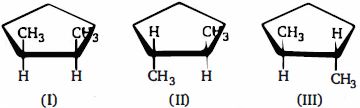
Among the structures given , select the enantiomers
  • A
    $I$ and $II$
  • B
    $I$ and $III$
  • $II$ and $III$
  • D
    $I, II$ and $III$

Answer

Correct option: C.
$II$ and $III$
c
$(c)\, I$ is meso, $II$ and $III$ one mirror image of each other.

Need a full question paper?

Generate a complete, print-ready paper with questions like this in minutes — across 16+ boards, with answer keys.

Start Generating Free

Similar questions

In a reaction

$C{H_2} = C{H_2}\xrightarrow[{oxid}]{{Hypochloro}}$ $M\xrightarrow{R}\begin{array}{*{20}{c}}
  {C{H_2} - OH} \\ 
  {|\,\,\,\,\,\,\,\,\,\,\,\,\,\,\,\,\,\,\,\,} \\ 
  {C{H_2} - OH} 
\end{array}$

Where $M$ = molecule; $R$ = reagent $M$ and $R$ are

For the reaction :

Half-life does not depend on the concentration of the reactant. After $10 \,\min,$ volume of  $N_2$ gas is $20\, L$ and after the completion of reaction, it is $100\, L$. Hence, rate  constant is :- 
The process requiring the absorptionof energy is
Dissolving $120 \mathrm{~g}$ of urea (mol. wt. $60$) in $1000 \mathrm{~g}$ of water gave a solution of density $1.15 \mathrm{~g} / \mathrm{mL}$. The molarity of the solution is
Total number of stereoisomers of the $1,3$ -dichlorocyclohexane is
The orbital pictute of a triplet carbene can be drawn as
Two solutions $A$ and $B$ are prepared by dissolving $1\,g$ of non-volatile solutes $X$ and $Y$. respectively in $1\,kg$ of water. The ratio of depression in freezing points for $A$ and $B$ is found to be $1: 4$. The ratio of molar masses of $X$ and $Y$ is.
For a chemical reaction,$ A + 2B \to C + D,$ the rate of reaction increases three times, when concentration of $A$ only is increased nine times. While when concentration of $B$ only is increased $2\,times,$ then rate of reaction also increases $2\,times$. The order of this reaction is
Heat of neutralization of strong acid and weak base is
When an acyl chloride is heated with $Na$ salt of a carboxylic acid, the product is