$Ampere - hour$ is a unit of
Easy


Download our appand get started for free
Experience the future of education. Simply download our apps or reach out to us for more information. Let's shape the future of learning together!No signup needed.*
Similar Questions
- 1A force is represented by $\mathrm{F}=a \mathrm{x}^2+\mathrm{bt}^{1 / 2}$. Where $\mathrm{x}=$ distance and $\mathrm{t}=$ time. The dimensions of $\mathrm{b}^2 / \mathrm{a}$ are :View Solution
- 2To find the distance $d$ over which a signal can be seen clearly in foggy conditions, a railways engineer uses dimensional analysis and assumes that the distance depends on the mass density $\rho$ of the fog, intensity (power/area) $S$ of the light from the signal and its frequency $f$. The engineer find that $d$ is proportional to $S ^{1 / n}$. The value of $n$ is:View Solution
- 3According to Joule's law of heating, heat produced $H = {I^2}\,Rt$, where I is current, $R$ is resistance and $t$ is time. If the errors in the measurement of $I, R$ and t are $3\%, 4\% $ and $6\% $ respectively then error in the measurement of $H$ isView Solution
- 4View SolutionIdentify the pair of physical quantities which have different dimensions
- 5The diameter of a wire is measured with a screw gauge having least count $0.01\;mm$. Which of the following correctly expresses the diameter?View Solution
- 6View SolutionWhich of the following is not represented in correct unit
- 7Student $A$ and Student $B$ used two screw gauges of equal pitch and $100$ equal circular divisions to measure the radius of a given wire. The actual value of the radius of the wire is $0.322\, {cm}$. The absolute value of the difference between the final circular scale readings observed by the students $A$ and $B$ is .... .View Solution
[Figure shows position of reference $'O'$ when jaws of screw gauge are closed]
Given pitch $=0.1 \,{cm}$.
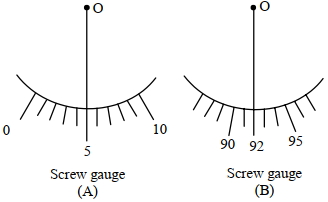
- 8For $z=a^{2} x^{3} y^{\frac{1}{2}}$, where $a$ is a constant. If percentage error in measurement of $x$ and $y$ are $4 \%$ and $12 \%$, respectively, then the percentage error for $z$ will be $%$View Solution
- 9The position of a particle at time $t$ is given by the relation $x(t) = \left( {\frac{{{v_0}}}{\alpha }} \right)\,\,(1 - {e^{ - \alpha t}})$, where ${v_0}$ is a constant and $\alpha > 0$. The dimensions of ${v_0}$ and $\alpha $ are respectivelyView Solution
- 10$Henry/ohm$ can be expressed inView Solution