MCQ
Ampere-hour is unit of :
  • A
    Power
  • Charge
  • C
    Energy
  • D
    Potential Difference

Answer

Correct option: B.
Charge
B

Need a full question paper?

Generate a complete, print-ready paper with questions like this in minutes — across 16+ boards, with answer keys.
Start Generating Free

Similar questions

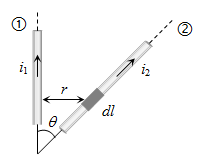
Wires $1$ and $2$ carrying currents $i_1$ and $i_2$ respectively are inclined at an angle $\theta$ to each other. What is the force on a small element dl of wire $2$ at a distance of $r$ from wire $1 ($as shown in figure$)$ due to the magnetic field of wire$1$
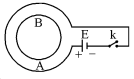
In the given figure, when key k is closed, then direction of induced current in the coil B IS:
Image
A hank of uninsulated wire consisting of seven and a half turns is stretched between two nails hammered into a board to which the ends of the wire are fixed. The resistance of the circuit between the nails is determined with the help of electrical measuring instruments. Determine the proportion in which the resistance will change if the wire is unwound so that the ends remain to be fixed to the nails.
In a Wheatstone's bridge all the four arms have equal resistance $R$. If the resistance of the galvanometer arm is also $R$, the equivalent resistance of the combination as seen by the battery is
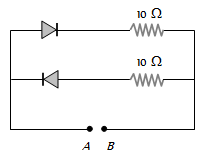
A $2V$ battery is connected across the points $A$ and $B$ as shown in the figure given below. Assuming that the resistance of each diode is zero in forward bias and infinity in reverse bias, the current supplied by the battery when its positive terminal is connected to $A$ is
Which of the following phenomena taken place when a monochromatic light is incident on a prism ?
A tuning fork of frequency 480Hz is used to vibrate a sonometer wire having natural frequency 410Hz. The wire will vibrate with a frequency.
  1. 410Hz
  2. 480Hz
  3. 820Hz
  4. 960Hz.
A positive point charge Q is brought near an isolated metal cube.
  1. The cube becomes negatively charged.
  2. The cube becomes positively charged.
  3. The interior becomes positively charged and the surface becomes negatively charged.
  4. The interior remains charge free and the surface gets nonuniform charge distribution.
What is the ratio of wavelength of radiations emitted when an electron in hydrogen atom jump from fourth orbit to second orbit and from third orbit to second orbit(a) 27 : 25(b) 20 : 27(c) 20 : 25(d) 25 : 27
       
The kinetic energy of an electron is $5\ eV.$ Calculate the de$-$Broglie wavelength associated with it $(h = 6.6 \times 10^{–34} Js, m_e = 9.1 \times 10^{–31} \ kg)$