MCQ
An acidic buffer solution can be prepared by mixing the solution of
- ✓sodium acetate and acetic acid
- Bammonium chloride and ammonium hydroxide
- Csulphuric acid and sodium hydroxide
- Dsodium chloride and sodium hydroxide
Generate a complete, print-ready paper with questions like this in minutes — across 16+ boards, with answer keys.
$x$ and $y$ mole consumed. Value of $x + y =$
$\begin{array}{*{20}{c}}
{\begin{array}{*{20}{c}}
{\,\,{R_1}} \\
|
\end{array}} \\
{R - C - X} \\
| \\
{\,\,{R_2}}
\end{array}\xrightarrow{{HOH}}\begin{array}{*{20}{c}}
{\begin{array}{*{20}{c}}
{\,\,{R_1}} \\
|
\end{array}\,\,\,\,\,} \\
{R - C - OH} \\
{|\,\,\,} \\
{{R_2}}
\end{array}$
Which substrate will give maximum racemisation?
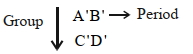
Which of the following is/are true about $\mathrm{A}^{\prime}, \mathrm{B}^{\prime}, \mathrm{C}^{\prime}$ and $\mathrm{D}^{\prime}$ ?
$A$. Order of atomic radii: $\mathrm{B}^{\prime}<\mathrm{A}^{\prime}<\mathrm{D}^{\prime}<\mathrm{C}^{\prime}$
$B$. Order of metallic character: $\mathrm{B}^{\prime}<\mathrm{A}^{\prime}<\mathrm{D}^{\prime}<\mathrm{C}^{\prime}$
$C$. Size of the element : $\mathrm{D}^{\prime}<\mathrm{C}^{\prime}<\mathrm{B}^{\prime}<\mathrm{A}^{\prime}$
$D$. Order of ionic radii : $\mathrm{B}^{\prime+}<\mathrm{A}^{\prime+}<\mathrm{D}^{\prime+}<\mathrm{C}^{\prime+}$
Choose the correct answer from the options given below :