MCQ
An acidic solution of dichromate is electrolyzed for $8$ minutes using $2$ $A$ current. As per the following equation

$Cr _{2} O _{7}^{2-}+14 H ^{+}+6 e ^{-} \rightarrow 2 Cr ^{3+}+7 H _{2} O$

The amount of $Cr ^{3+}$ obtained was $0.104\, g$. The

efficiency of the process(in\%) is

(Take : $F =96000\, C$, At. mass of chromium $=52$ )

  • $60$
  • B
    $56$
  • C
    $64$
  • D
    $50$

Answer

Correct option: A.
$60$
a
Moles of $e ^{\ominus}=\left(\frac{8 \times 60 \times 2}{96000}\right)$

Using stoichiometry; theoritically

$\frac{ n _{ e ^{\ominus}} used }{6}=$$\frac{ n _{ cr ^{+3}} \text {produced }}{2}$

$\Rightarrow n _{ cr ^{+3}}$ produced $=\frac{2}{6} \times \frac{8 \times 60 \times 2}{96000}$

$=\frac{0.02}{6}$

$\Rightarrow wt _{ cr ^{+3}}$ theoritically produced

$=\left(\frac{0.02}{6} \times 52\right) g$

$\Rightarrow \%$ efficiency $=\frac{0.104 g }{\left(\frac{0.02 \times 52}{6}\right) g } \times 100$

$=60 \%$

Need a full question paper?

Generate a complete, print-ready paper with questions like this in minutes — across 16+ boards, with answer keys.

Start Generating Free

Similar questions

The standard enthalpy or the decomposition of ${N_2}{O_5}$ to $N{O_2}$ is $58.04$ $kJ$ and standard entropy of this reaction is $176.7\,J/K$. The standard free energy change for this reaction at ${25\,^o}C$ is .................. $\mathrm{kJ}$
Which one of the following compounds is inactive towards $S _{ N } 1$ reaction?
Given below are two statements, one is labeled as Assertion $(A)$ and other is labeled as Reason $(R).$

Assertion $(A):$ Gabriel phthalimide synthesis cannot be used to prepare aromatic primary amines.

Reason $(R) :$ Aryl halides do not undergo nucleophilic substitution reaction.

In the light of the above statements, choose the correct answer form the options given below.

Rank the following compounds in order of increasing basic strength. (weakest $\to$ strongest)
Select the reaction $(s)$ that would result in the formation of $2$ -bromopropane.

$(I) \,C{H_3}CH = C{H_2} + HBr\xrightarrow{{peroxide}}$

$(II)\, C{H_3}CH = C{H_2} + HBr\xrightarrow{{CC{l_4}}}$

$(III)\, C{H_3}C{H_2}C{H_3} + B{r_2}\xrightarrow{{hv}}$

$(IV)\,C{H_3}CH = C{H_2} + B{r_2}\xrightarrow{{CC{l_4}}}$

Aluminium oxide may be electrolysed at $1000\,^o C$  to furnish aluminium metal (At. Mass $= 27\ amu$; $1$  Faraday $= 96,500$ Coulombs). The cathode reaction is $Al^3 + 3{e^ - } \to Al^\circ $ To prepare $5.12\,kg$  of aluminium metal by this method would require
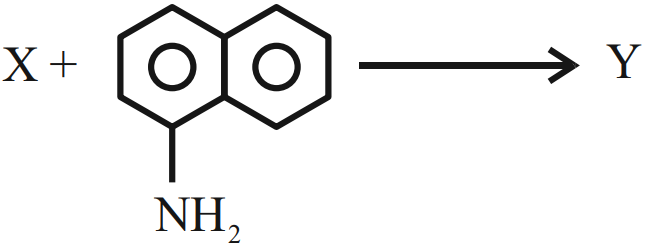
The azo-dye $( Y )$ formed in the following reactions is Sulphanilic acid $+ NaNO _2+ CH _3 COOH \rightarrow X$

Image
In 3, 3-dimethylhex-1-ene-4-yne, there are __________ $\mathrm{sp}^{3}$, __________ $\mathrm{sp}^{2}$ and __________ sp hybridised carbon atoms respectively :
Ethylene react with $Br_2$ give $1,2-$ Dibromoethane intermediate of reaction is
The compound $X,$ in the reaction, is $ X\xrightarrow{{C{H_3}MgI}}Y\xrightarrow{{hydrolysis}}Mg(OH)I + C{H_3}COOH$