MCQ
An air bubble just inside a soap solution and a soap bubble blown using the same solution have their radii in the ratio $3: 2$. The ratio of the excess pressure inside them is
  • A
    $1: 12$
  • B
    $1: 6$
  • $1: 3$
  • D
    $1: 2$.

Answer

Correct option: C.
$1: 3$
$1: 3$

Need a full question paper?

Generate a complete, print-ready paper with questions like this in minutes — across 16+ boards, with answer keys.
Start Generating Free

Similar questions

An electron is moving in an orbit of a hydrogen atom from which there can be a maximum of six transitions. An electron is moving in an orbit of another hydrogen atom from which there can be a maximum of three transitions. The ratio of the velocity of the electron in these two orbits is
In Young's double slit experiment, the fringe wid th is $2 mm$. The separation between the $13^{\text {th }}$ bright fringe and the $4^{\text {th }}$ dark fringe from the centre of the screen on same side will be
The mean free path λ of molecules is given by
When a motorcyclist takes a circular turn on a level race track, the centripetal force is
Two uniform solid spheres, of the same mass but radii in the ratio $R_1: R_2=1: 2$, roll without slipping on a plane surface with the same total kinetic energy. The ratio $\omega_1: \omega_2$ of their angular speed is
In Balmer series, wavelength of first line is $\lambda_1$ and in Brackett series wavelength of first line is $\lambda_2$, then $\lambda_1 / \lambda_2$ is
A black rectangular surface of area $A$ emits energy $E$ per second at $27^{\circ} C$. If length and breadth are reduced to $1 / 3^{\text {rd }}$ of initial value and temperature is raised to $327^{\circ} C$ then energy emitted per second becomes
A film of soap solution is formed between two straight parallel wires of length $10 cm$ each separated by $0.5 cm$. If their separation is increased by $1 mm$ while still maintaining their parallelism. How much work will have to be done? (surface tension of solution $=65 \times 10^{-2} N / m$ )
A conducting wire of length $2500 m$ is kept in east-west direction, at a height of $10 m$ from the ground. If it falls freely on the ground then the current induced in the wire is (Resistance of wire $=25 \sqrt{2} \Omega$, acceleration due to gravity $g=10 m / s ^2$, $B_H=2 \times 10^{-5} T$ )
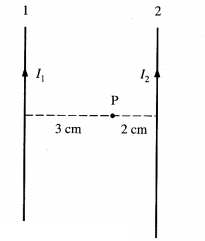
Two long, straight, parallel wires are $5 \ cm$ apart and carry currents $I_1$ and $I_2$ in the same direction. If $2I_1 = 3I_2,$ then at a point $P, 2 \ cm$ from wire $2,$Image ​​​​​​​