MCQ
An air column, closed at one end and open at the other, resonates with a tuning fork when the smallest length of the column is $50\, cm.$ The next larger length of the column resonating with the same tuning fork is .... $cm$
  • A
    $100$
  • $150$
  • C
    $200$
  • D
    $66.7$

Answer

Correct option: B.
$150$
b
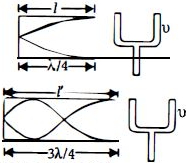
From figure,

First harmonic is obtained at

$l=\frac{\lambda}{4}=50 \mathrm{cm}$

Third harmonic is obtained for resonance,

$l^{\prime}=\frac{3 \lambda}{4}=3 \times 50=150 \mathrm{cm}$

Need a full question paper?

Generate a complete, print-ready paper with questions like this in minutes — across 16+ boards, with answer keys.

Start Generating Free

Similar questions

A ring, a solid sphere, a disc and a solid cylinder of same radii roll down an inclined plane, which would reach the bottom in the last
The motion of a particle is described by the equation $x = a + b{t^2}$ where $a = 15\, cm$ and $b = 3 \,cm/s^2$. Its instantaneous velocity at time $3\, sec$ will be........$cm/sec$
A tuning fork $A$ of frequency $200 Hz$ is sounded with fork $B,$ the number of beats per second is $5.$ By putting some wax on $A,$ the number of beats increases to $8.$ The frequency of fork $B$ is  .... $Hz$
If the resultant of the two forces has a magnitude smaller than the magnitude of larger force, the two forces must be
$A V$-shaped rigid body has two identical uniform arms. What must be the angle between the two arms, so that when the body is hung from one end the other arm is horizontal?
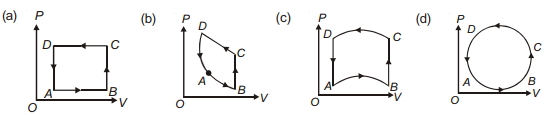
In following figures $(a)$ to $(d)$, variation of volume by change of pressure is shown in figure. The gas is taken along the path $A B C D A$. Change in internal energy of the gas will be .......
The potential energy $u$ of a particle varies with distance $x$ from a fixed origin as $u=\frac{A \sqrt{x}}{x+B}$, where $A$ and $B$ are constants. The dimensions of $A$ and $B$ are respectively
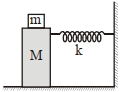
In the given figure, a mass $M$ is attached to a horizontal spring which is fixed on one side to a rigid support. The spring constant of the spring is $k$. The mass oscillates on a frictionless surface with time period $T$ and amplitude $A$. When the mass is in equilibrium position, as shown in the figure, another mass $m$ is gently fixed upon it. The new amplitude of oscillation will be
A uniform circular disc of mass $50 \ kg$ and radius $0.4 \ m$ is rotating with an angular velocity of $10 \ rad / s ^{-1}$ about its own axis, which is vertical. Two uniform circular rings, each of mass $6.25 \ kg$ and radius $0.2 \ m$, are gently placed symmetrically on the disc in such a manner that they are touching each other along the axis of the disc and are horizontal. Assume that the friction is large enough such that the rings are at rest relative to the disc and the system rotates about the original axis. The new angular velocity (in $rad s ^{-1}$ ) of the system is :
If temperature of gas increases from $27°C$ to $927°C$ the $K.E.$ will be