MCQ
An aircraft is moving with a velocity of $300\,m{s^{ - 1}}.$ If all the forces acting on it are balanced, then
  • It still moves with the same velocity
  • B
    It will be just floating at the same point in space
  • C
    It will fall down instantaneously
  • D
    It will lose its velocity gradually

Answer

Correct option: A.
It still moves with the same velocity
a
$F = ma$

If the forces are balanced, $F=0$, which implies $a=0$. If there's no acceleration, then the velocity is constant. The solutions are trajectories of constant velocity, which means the aircraft will move along a straight line with uniform speed.

Need a full question paper?

Generate a complete, print-ready paper with questions like this in minutes — across 16+ boards, with answer keys.

Start Generating Free

Similar questions

The acceleration due to gravity at height $h$ above the earth if $h \ll R$ (radius of earth) is given by
A bob of mass $m$, suspended by a string of length $I_1$, is given a minimum velocity required to complete a full circle in the vertical plane, At the highest point, it collides elastically with another bob of mass $m$ suspended by a string of length $I_2$, which is initially at rest. Both the strings are mass-less and inextensible. If the second bob, after collision acquires the minimum speed required to complete a full circle in the vertical plane, the ratio $\frac{I_1}{I_2}$ is :
The displacement $x$ of a particle along a straight line at time $t$ is given by $x = {a_0} + {a_1}t + {a_2}{t^2}$. The acceleration of the particle is
A block of mass $10\, kg,$ moving in $x$ direction with a constant speed of $10\, m s^{-1}$, is subjected to a retarding force $F= 0.1\,x \,J/m$ during its travel from $x = 20 \,m $ to $30\, m$. Its final $KE$ will be ............... $\mathrm{J}$
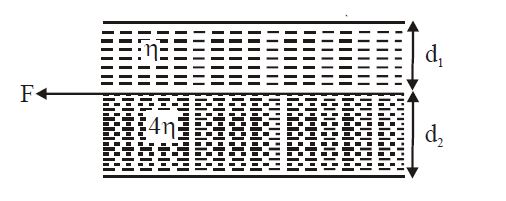
A thin plate separates two liquids of coefficients of viscosity $\eta$ and $4\ \eta$ kept between two fixed plates as shown. If plate has to be pulled by applying minimum force then $\frac{d_2}{d_1}$ is
Consider the following two statements: $(A)$ The linear momentum of a particle is independent of the frame of reference. $(B)$ The kinetic energy of a particle is independent of the frame of reference.
$\vec{A}$ is a vector of magnitude $2.7$ units due east. What is the magnitude and direction of vector $4 \vec{A}$ ?
The total work done on a particle is equal to the change in its kinetic energy:
If two moles of diatomic gas and one mole of mono atomic gas are mixed then the ratio of specific heats $\gamma=$ ......
The moment of inertia of a body about a given axis is $2.4\ kg-m^2$.  To produce a rotational kinetic energy of $750\ J$, an angular acceleration of $5\ rad/s^2$ must be applied about that axis for.......... $\sec$