Question
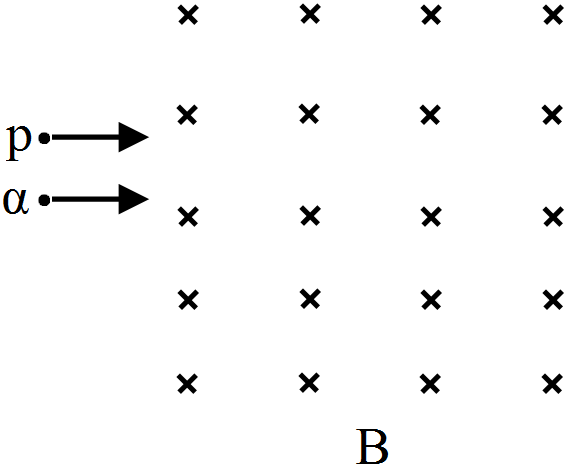
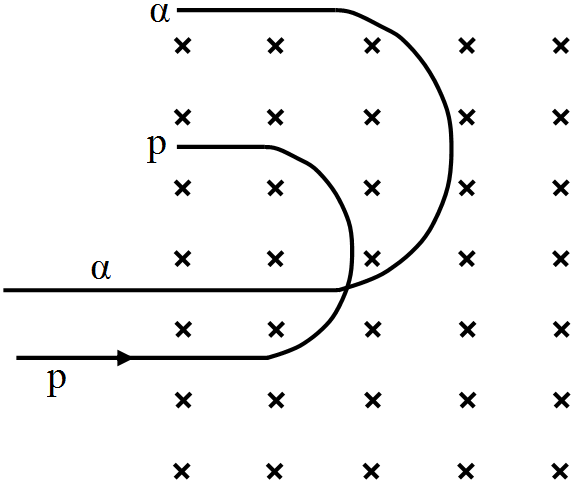
An $\alpha$-particle and a proton moving with the same speed enter the same magnetic field region at right angles to the direction of the field. Show the trajectories followed by the two particles in the region of the magnetic field. Find the ratio of the radii of the circular paths which the two particles may describe.
Answer

Radius of charged particle in magnetic field.
$\text{r}=\frac{\text{mv}}{\text{qB}}$
$\text{r}\propto\frac{\text{m}}{q}$ for same $\upsilon$ and B.
$\frac{\text{r}_\text{p}}{\text{r}_\alpha}=\frac{(\text{m/q})_\text{p}}{(\text{m/q})_\alpha}$
$=\frac{(\text{m}_p/e)}{((4\text{m}_\text{p})/2\text{e})}=\frac{1}{2}$

Need a full question paper?

Generate a complete, print-ready paper with questions like this in minutes — across 16+ boards, with answer keys.

Start Generating Free

Similar questions

In the given circuit, with steady current, calculate the potential difference across the capacitor and the charge stored in it.
Explain how resistance of conductor depends on the dimension of the conductor and derive its equation.
If the bar magnet in exercise 5.13 is turned around by 180°, where will the new null points be located?
Which constituent radiation of the electromagnetic spectrum is used:
  1. In RADAR,
  2. To photograph internal parts of a human body,
  3. For taking photographs of the sky during night and foggy conditions?
Give one reason for your answer in each case.
A uniform disc of mass m and radius r is suspended through a wire attached to its centre. If the time period of the torsional oscillations be T, what is the torsional constant of the wire.
A current loop of arbitrary shape lies in a uniform magnetic field B. Show that the net magnetic force acting on the loop is zero.
(i) What is meant by electric power? Prove that $P=\frac{V^2}{R}$ or $P=I^2 R$. Define one-watt electric power.(ii) Define electric energy. Prove that $P = I ^2 R \Delta t$
Find the speed of the electron in the ground state of a hydrogen atom. The description of ground state is given in the previous problem.
A converging lens and a diverging mirror are placed at a separation of 15cm. The focal length of the lens is 25cm and that of the mirror is 40cm. Where should a point source be placed between the lens and the mirror so that the light, after getting reflected by the mirror and then getting transmitted by the lens, comes out parallel to the principal axis?
Prove that the current density of a metallic conductor is directly proportional to the drift speed of electrons.