MCQ
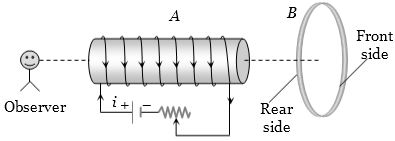
An aluminium ring $B$ faces an electromagnet $A$. The current I through $A$ can be altered
  • A
    Whether $I$ increases or decreases, $B$ will not experience any force
  • B
    If $I$ decrease, $A$ will repel $B$
  • C
    If $I$ increases, $A$ will attract $B$
  • If $I$ increases, $A$ will repel $B$

Answer

Correct option: D.
If $I$ increases, $A$ will repel $B$
d
(d) If current through $A$ increases, crosses $(X)$ linked with coil $B$ increases, hence anticlockwise current induces in coil $B$. As shown in figure both the current produces repulsive effect.

Need a full question paper?

Generate a complete, print-ready paper with questions like this in minutes — across 16+ boards, with answer keys.

Start Generating Free

Similar questions

Condenser $A$ has a capacity of $15\,\mu F$ when it is filled with a medium of dielectric constant $15$. Another condenser $B$ has a capacity of $1\,\mu F$ with air between the plates. Both are charged separately by a battery of $100\;V$. After charging, both are connected in parallel without the battery and the dielectric medium being removed. The common potential now is.....$V$
The resistance of a wire of iron is $10\, ohms$ and temp. coefficient of resistivity is $5 \times {10^{ - 3}}\,^oC$. At $20\,^oC$ it carries $30$ milliamperes of current. Keeping constant potential difference between its ends, the temperature of the wire is raised to $120\,^oC$. The current in milliamperes that flows in the wire is
A square shaped wire with resistance of each side $3\, \Omega$ is bent to form a complete circle. The resistance between two diametrically opposite points of the circle in unit of $\Omega$ will be ......
The mass of a photo electron is
The pitch and the number of divisions, on the circular scale, for a given screw gauge are $0.5\,mm$ and $100$ respectively. When the screw gauge is fully tightened without any object, the zero of its circular scale lies $3$ divisions below the mean line. The readings of the main scale and the circular scale for a thin sheet, are $5.5\,mm$ and $48$ respectively, the thickness of this sheet is
The ratio of coulomb's electrostatic force to the gravitational force between an electron and a proton separated by some distance is $2.4 \times 10^{39}$. The ratio of the proportionality constant, $K=\frac{1}{4 \pi \varepsilon_0}$ to the Gravitational constant $G$ is nearly (Given that the charge of the proton and electron each $=1.6 \times 10^{-19}\; C$, the mass of the electron $=9.11 \times 10^{-31}\; kg$, the mass of the proton $=1.67 \times 10^{-27}\,kg$ ):
State which of the following is correct
Ultraviolet radiations of $6.2\,eV$ falls on an aluminium surface (work function $4.2\;eV$). The kinetic energy in joules of the fastest electron emitted is approximately
The armature of $dc$ motor has $20\,\Omega $ resistance. It draws current of $1.5$ $ampere$ when run by $220 \,volts$ $dc$ supply. The value of back $e.m.f$. induced in it will be......$V$
One projectile moving with velocity $v$ in space, gets burst into $2$ parts of masses in the ratio $1 : 3$ . The smaller part becomes stationary. What is the velocity of the other part ?