MCQ
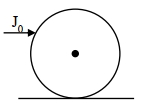
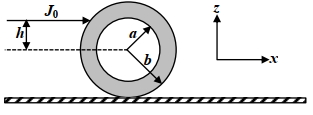
An annular disk of mass $M$, inner radius $a$ and outer radius $b$ is placed on a horizontal surface with coefficient of friction $\mu$, as shown in the figure. At some time, an impulse $J_0 \hat{x}$ is applied at a height $\mathrm{h}$ above the center of the disk. If $h=h_m$ then the disk rolls without slipping along the $x$-axis. Which of the following statement(s) is(are) correct?

(image)

($A$) For $\mu \neq 0$ and $a \rightarrow 0, h_m=b / 2$

($B$) For $\mu \neq 0$ and $a \rightarrow b, h_m=b$

($C$) For $h=h_m$, the initial angular velocity does not depend on the inner radius $a$.

($D$) For $\mu=0$ and $h=0$, the wheel always slides without rolling.
  • A
    $A,D$
  • B
    $A,B$
  • C
    $A,B,C$
  • $A,B,C,D$

Answer

Correct option: D.
$A,B,C,D$
d
$\mathrm{J}_0=\mathrm{mv} \ldots . .(1)$

$\mathrm{J}_0 \mathrm{~h}_{\mathrm{m}}=\mathrm{I}_{\mathrm{c}} \omega \ldots \ldots .(2)$

$\mathrm{v}=\omega \mathrm{R} \ldots \ldots .(3)$

$\Rightarrow \mathrm{h}_{\mathrm{m}}=\frac{\mathrm{I}_{\mathrm{c}}}{\mathrm{mR}}$

$(A)$ If $\mathrm{a}=0 \mathrm{I}_{\mathrm{c}}=\frac{1}{2} \mathrm{mb}^2 \& \mathrm{R}=\mathrm{b} \quad \therefore \mathrm{h}_{\mathrm{m}}=\frac{\mathrm{b}}{2}$

$(B)$ If $\mathrm{a}=\mathrm{b} \mathrm{I}_{\mathrm{C}}=\mathrm{mb}^2 \& \mathrm{R}=\mathrm{b} \therefore \mathrm{h}_{\mathrm{m}}=\mathrm{b}$

$(C)$ $\mathrm{v}=\frac{\mathrm{J}_0}{\mathrm{~m}} \Rightarrow 100=\frac{\mathrm{V}}{\mathrm{R}}=\frac{\mathrm{J}_0}{\mathrm{mR}}$

$(D)$ Force is acting on COM $\therefore$ No rotation.

Need a full question paper?

Generate a complete, print-ready paper with questions like this in minutes — across 16+ boards, with answer keys.

Start Generating Free

Similar questions

Which of the following is the disadvantage of $FM$ over $AM$
The fact that electric charges are integral multiples of the fundamental electronic charge was proved experimentally by
Current in the circuit is wattless, if
The mass of a nucleus ${ }_Z^A X$ is less that the sum of the masses of $(A-Z)$ number of neutrons and $Z$ number of protons in the nucleus. The energy equivalent to the corresponding mass difference is known as the binding energy of the nucleus. A heavy nucleus of mass $M$ can break into two light nuclei of masses $m_1$ and $m_2$ only if $\left(m_1+m_2\right)M^{\prime}$. The masses of some neutral atoms are given in the table below:

${ }_1^1 H$  $1.007825 u$ ${ }_2^1 H$ $2.014102 u$ ${ }_3^1 H$ $3.016050 u$ ${ }_2^4 He$ $4.002603 u$
${ }_3^6 Li$ $6.015123 u$ ${ }_7^3 Li$ $7.016004 u$ ${ }_70^30 Zn$ $69.925325 u$ ${ }_{34}^{82} Se$ $81.916709 u$
${ }_{64}^{152} Gd$ $151.919803 u$ ${ }_{206}^{82} Gd$ $205.974455 u$ ${ }_{209}^{83} Bi$ $208.980388 u$ ${ }_{84}^{210} Po$ $209.982876 u$

$1.$ The correct statement is:

$(A)$ The nucleus ${ }_3^6 Li$ can emit an alpha particle

$(B)$ The nucleus ${ }_{84}^{210} P_0$ can emit a proton

$(C)$ Deuteron and alpha particle can undergo complete fusion.

$(D)$ The nuclei ${ }_{30}^{70} Zn$ and ${ }_{34}^{82} Se$ can undergo complete fusion.

$2.$ The kinetic energy (in $keV$ ) of the alpha particle, when the nucleus ${ }_{84}^{210} P _0$ at rest undergoes alpha decay, is:

$(A)$ $5319$ $(B)$ $5422$ $(C)$ $5707$ $(D)$ $5818$

Give the answer question $1$ and $2.$

Fusion reaction is initiated with the help of
In displacement method, convex lens forms a real image of an object for its two different positions. If heights of the images in two cases be $24 \,cm$ and $6 \,cm$, then the height of the object is ........ $cm$
A circular disc is to be made by using iron and aluminium, so that it acquires maximum moment of inertia about its geometrical axis.  It is possible with
The $I-V$ characteristic of an $LED$ is
Two point charges $3 \times 10^{-6} \,C$ and  $8 \times 10^{-6} \, C$ repel each other by a force of  $6 \times 10^{-3} \, N$. If each of them is given an additional charge $-6 \times 10^{-6} \, C$, the force between them will be
Two particles $P$ and $Q$ describe $SHM$ of same amplitude $a$ , frequency $v$ along the same straight line. The maximum distance between the two particles is $a \sqrt 2$ . The initial phase difference between the particles is