Question
An aromatic compound 'A' on treatment with aqueous ammonia and heating forms compound 'B' which on heating with $Br _2$ and KOH forms a compound ' C ' of molecular formula $C _6 H _7 N$. Write the structures and IUPAC names of compound $A , B$ and C .

Answer

Step - 1: To find out the structure of compounds ' B ' and ' C '.
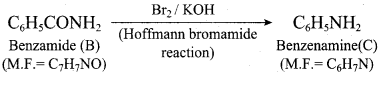
1. Since compound ' C ' with molecular formula $C _6 H _7 N$ is formed from compound ' B ' on treatment with $Br _2+ KOH$ (i.e., Hoffmatm bromamide reaction). Therefore, compound ' B ' must be an amide and ' C ' must be an amine. The only amine having the molecular formula $C _6 H _7 N$ is $C _6 H _5 NH _2$ (i.e., aniline or benzenamine).
2. Since ' C ' is aniline, therefore, the amide from which it is formed must be benzamide $\left( C _6 H _5 CONH _2\right)$. Thus, compound ' B ' is benzamide. The chemical equation showing the conversion of ' B ' to ' C ' is
Image
To find out the structure of compound ‘A’. Since compound ‘B’ is formed from compound ‘A’ by treatment with aqueous ammonia and heating. Therefore, compound ‘A’ must be benzoic acid or benzenecarboxylic acid.Image

Need a full question paper?

Generate a complete, print-ready paper with questions like this in minutes — across 16+ boards, with answer keys.

Start Generating Free

Similar questions

 (a) Give reasons for the following
- Rusting of iron is quicker in saline water than in ordinary water.
- Aluminium metal cannot be produced by the electrolysis of aqueous solution of aluminium salt.
(b) Resistance of a conductivity cell filled with 0.1 M KCl solution is 100 ohms. If the resistance of the sanie cell when filled with 0.02 M KCl solution is 520 ohms, calculate the conductivity and molar conductivity of 0.02 M KCl solution. Conductivity of 0.01 M KCl solution is $1.29 S m ^{-1}$..
 An organic compound $(A)$ of molecular formula $C _2 H _6 O$ reacts $P /{ }_2$ gives $(B)$ which on further reaction with silver nitrite gives $( C )$ of formula $C _2 H _5 NO _2$. (C) on treatment with nitrous acid yield (D) of formula $C _2 H _4 N_2 O _3$. (D) on reaction with KOH give red color product ( $E$ ). Identify $A , B , C , D$ and E . From the final product (E) red colour product, it is identified these reactions are the reactions of primary alcohols in Victor Meyer's test.
What is esterification? Explain the mechanism of esterification.
Explain Buffer action with suitable example.
Explain the mechanism of cleansing action of soaps and detergents.
Assuming complete dissociation, calculate the pH of the following solutions.
(i) 0.003 M HCl
(ii) 0.005 M NaOH
(iii) 0.002 M HBr
(iv) 0.002 M KOH
Convert aniline into the following compounds.
(i) N – phenyl benzamide
(ii) Phenyl isothiocyanate
(iii) 2, 4, 6 – tribromo aniline
(iv) Sulphanilinic acid
(v) Phenyl isocyanide
A substance reacts according to the first order rate law and the specific reaction rate for the reaction ¡s $1 \times 10^{-2} s^{-1}$ If the initial concentration is 1.0 M.
  1. What is the initial rate?
  2. What ¡s the reaction rate after 1 minute?
Explain about the magnetic properties of transition elements.
An alkene (A) on ozonolysis gives propanone and aldehyde (B). When (B) is oxidised (C) is obtained. (C) is treated with $Br _2 / P$ gives (D) which on hydrolysis gives (E). When propanone is treated with HCN followed by hydrolysis gives (E). Identify A, B, C, D and E.