MCQ
An artificial satellite revolves around a planet for which gravitational force $(F)$ varies with distance $r$ from its centre as $F \propto r^2$. If $v_0$ its orbital speed, then
  • A
    $v_0 \propto r^{-1 / 2}$
  • $v_0 \propto r^{3 / 2}$
  • C
    $v_0 \propto r^{-3 / 2}$
  • D
    $v_0 \propto r$

Answer

Correct option: B.
$v_0 \propto r^{3 / 2}$
b
(b)

Gravitational force $(F)$ provides the necessary centripetal force to keep the satellite in orbit,

$\Rightarrow \frac{m v_0^2}{r} \propto F$

$\frac{m v_0^2}{r} \propto r^2$

$v_0 \rightarrow \text { Orbital speed }$

$r \rightarrow \text { Radius of orbit }$

$\Rightarrow v_0 \propto r^{3 / 2}$

Need a full question paper?

Generate a complete, print-ready paper with questions like this in minutes — across 16+ boards, with answer keys.

Start Generating Free

Similar questions

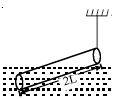
A slender homogeneous rod of length $2L$ floats partly immersed in water, being supported by a string fastened to one of its ends, as shown. The specific gravity of the rod is $0.75$. The length of rod that extends out of water is : 
A body starts from rest and travels a distance $S$ with uniform acceleration, then moves uniformly a distance $2S$ and finally comes to rest after moving further $3S$ under uniform retardation. The ratio of the average velocity to maximum velocity is
 What is the average velocity of the molecules of an ideal gas?
A simple pendulum, made of a string of length $l$ and a bob of mass $m$ , is released from a small angle $\theta_0$. It strikes a block of mass $M$, kept on a horizontal surface at its lowest point of oscillations, elastically. It bounces back and goes up to an angle $\theta_1$. Then $M$ is given by
A block of mass $0.50\ kg$ is moving with a speedof $2.00$ $ms^{-1}$ on a smooth surface. It strikes another mass of $1.00\ kg$ and then they move together as a single body. The energy loss during the collision is ............. $\mathrm{J}$
The motion of a particle of mass m is given by $\text{x}=0$ for $\text{t} < 0\ \text{s},$ $\text{x}(\text{t})=\text{A}\sin4\text{p}\ \text{t}$ for $0<\text{t}<(1/ 4)\ \text{s}(\text{A}>\text{o}),$ and $\text{x}=0$ for $\text{t}>(1/4)\ \text{s}.$ Which of the following statements is true?
Two similar wires under the same load yield elongation of $0.1$ $mm$ and $0.05$ $mm$ respectively. If the area of cross- section of the first wire is $4m{m^2},$ then the area of cross section of the second wire is..... $mm^2$
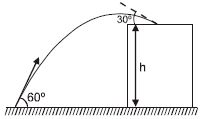
A stone projected at an angle of $60^o$ from the ground level strikes at an angle of $30^o$ on the roof of a building of height $‘h= 30\,m ’$ . Find the speed of projection(in $m/s$ ) of the stone
The relative uncertainty in the period of a sateilite orbiting around the earth is $10^{-2}$. If the relative uncertainty in the radius of the orbit is negligible, the relative uncertainty in the mass of the earth is
The power of a pump, which can pump $500 \,kg$ of water to height $100 \,m$ in $10 \,s$ is .......... $kW$