Question
An astronomical telescope is an optical instrument which is used for observing distinct images of heavenly bodies libe stars, planets etc. It consists of two lenses. In normal adjustment of telescope, the final image is formed at infinity. Magnifying power of an astronomical telescope in normal adjustment is defined as the ratio of the angle subtended at the eye by the angle subtended at the eye by the final image to the angle subtended at the eye, by the object directly, when the final image and the object both lie at infinite distance from the eye. It is given by, $\text{m}=\frac{\text{f}_0}{\text{f}_\text{g}}.$ To increase magnifying power of an astronomical telescope in normal adjustment, focal length of objective lens should be large and focal length of eye lens should be small.
  1. An astronomical telescope of magnifying power 7 consists of the two thin lenses 40cm apart, in normal adjustment. The focal lengths of the lenses are
  1. 5cm, 35cm
  2. 7cm, 35cm
  3. 17cm, 35cm
  4. 5cm, 30cm
  1. An astronomical telescope has a magnifying power of 10. In normal adjustment, distance between the objective and eye piece is 22cm. The focal length of objective lens is:
  1. 25cm
  2. 10cm
  3. 15cm
  4. 20cm
  1. In astronomical telescope compare to eye piece, objective lens has:
  1. Negative focal length.
  2. Zero focal length.
  3. Small focal length.
  4. Large focal length.
  1. To see stars, use:
  1. Simple microscope.
  2. Compound microscope.
  3. Endoscope.
  4. Astronomical telescope.
  1. For large magnifying power of astronomical telescope.
  1. f0 << fe
  2. f0 << fe
  3. f0 << fe
  4. None of these.

Answer

  1. (a) 5cm, 35cm

Explanation:

$\text{m}=\frac{\text{f}_0}{\text{f}_\text{e}}=7$

$\text{f}_0=7\text{f}_e$

In normal adjustment, distance between the lenses,

$\text{f}_0+\text{f}_\text{e}=40$

$7\text{f}_0+\text{f}_\text{e}=40\Rightarrow\text{f}_\text{e}=\frac{40}{8}=5\text{cm}$

$\text{f}_0=7\text{f}_\text{e}=7\times5=35\text{cm}$

  1.  (d) 20cm

Explanation:

$\text{m}=-10;\text{L}=22\text{cm}$

As, $\text{m}=\frac{-\text{f}_0}{\text{f}_e}\Rightarrow-10=-\frac{\text{f}_0}{\text{f}_\text{e}}$

$\text{f}_0=10\text{f}_\text{e}$

As, $\text{L}=\text{f}_0+\text{f}_\text{e}$

$22=10\text{f}_\text{e}+\text{f}_e=11\text{f}_\text{e}$

or $\text{f}_\text{e}=\frac{22}{11}=2\text{cm}$

$\text{f}_0=10\text{f}_\text{e}=20\text{cm}$

  1.  (d) Large focal length.

Explanation:

Objective lens has larger focal length than eye-piece.

  1.  (d) Astronomical telescope.

Explanation:

Astronomial telescope is used to see stars, sun etc.

  1. (c) f0 << fe

Need a full question paper?

Generate a complete, print-ready paper with questions like this in minutes — across 16+ boards, with answer keys.

Start Generating Free

Similar questions

In motor vehicles, a convex mirror is attached near the driver's seat to give him the view of the traffic behind. What is the special function of this convex mirror which a plane mirror can not do?
When tall buildings are constructed on earth, the duration of day-night slightly increases. Is it true?
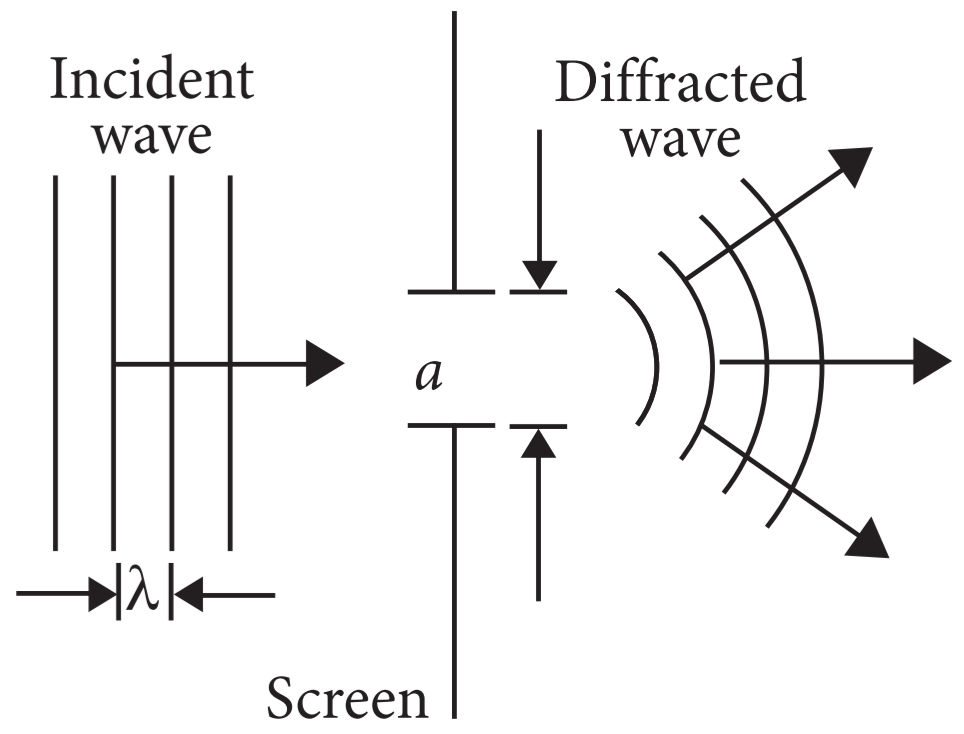
The phenomenon of bending ofli ght around the sharp corners and the spreading of light within the geometrical shadow of the opaque obstacles is called diffraction of light. The light thus deviates from its linear path. The deviation becomes much more pronounced, when the dimensions of the aperture or the obstacle are comparable to the wavelength of light.

  1. Light seems to propagate in rectilinear path because.
  1. Its spread is very large.
  2. Its wavelength is very small.
  3. Reflected from the upper surface of atmosphere.
  4. It is not absorbed by atmosphere.
  1. ln diffraction from a single slit the angular width of the central maxima does not depends on:
  1. $\lambda$ of light used.
  2. Width of slit.
  3. Distance of slits from the screen.
  4. Ratio of $\lambda$ and slit width.
  1. For a diffraction from a single slit, the intensity of the central point is:
  1. Infinite.
  2. Finite and same magnitude as the surrounding maxima.
  3. Finite but much larger than the surrounding maxima.
  4. Finite and substantially smaller than the surrounding maxima.
  1. Resolving power of telescope increases when:
  1. Wavelength of light decreases.
  2. Wavelength of light increases.
  3. Focal length of eye-piece increases.
  4. Focal length of eye-piece decreases.
  1. ln a single diffraction pattern observed on a screen placed at D metre di stance from the slit of width d metre, the ratio of the width of the central maxima to the width of other secondary maxima is:
  1. 2 : 1
  2. 1 : 2
  3. 1 : 1
  4. 3 : 1
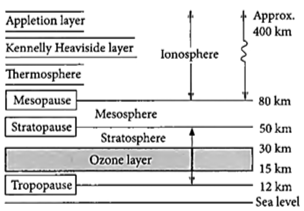
Radio waves are produced by the accelerated motion of charges in conducting wires. Microwaves are produced by special vacuum tubes. Infrared waves are produced by hot bodies and molecules also known as heat waves. UV rays are produced by special lamps and very hot bodies like Sun. 
Image
(i) Solar radiation is
i. transverse electromagnetic wave
ii. longitudinal electromagnetic waves
iii. both longitudinal and transverse electromagnetic waves
iv. none of these.
(a) Option (i)  (b) Option (iv)  (c) Option (iii)  (d) Option (ii)

(ii) What is the cause of greenhouse effect?
(a) Ultraviolet rays (b) X-rays (c) Infrared rays (d) Radiowaves

(iii) Biological importance of ozone layer is
(a) it stops ultraviolet rays
(b) none of these.
(c) it reflects radiowaves
(d) It layer reduces greenhouse effect

OR

Earth's atmosphere is richest in
(a) ultraviolet (b) infrared (c) X-rays (d) microwaves

(iv) Ozone is found in
(a) troposphere (b) mesosphere (c) ionosphere (d) stratosphere
To keep valuable instruments away from the earth's magnetic field, they are enclosed in iron boxes. Explain.
What do you mean by nuclear fission ?
On disintegration of one atom of ${}^{235}U$ the amount of energy obtained is 200 MeV. The power obtained in a reactor is 1000 kilowatt. How many atoms are disintegrated per second in the reactor? What is the decay in mass per hour?
Plot a graph showing variation of de-Broglie wavelength $ \lambda $ versus $ 1/\sqrt{V} $ where V is accelerating potential for two particles A and B carrying same charge but of masses $ m_{1} $ and $ m_{2} $, where $ m_{1}>m_{2} $
Out of the two magnetic materials, 'A' has relative permeability slightly greater than unity while 'B' has less than unity. Identify the nature of the materials 'A' and 'B'. Will their susceptibilities be positive or negative?
You are waiting for a train on a railway platform. Your three year old niece is standing on your iron trunk containing the luggage. Why does the trunk not recoil as she jumps off on the platform?
The needle of a dip circle shows an apparent dip of 45° in a particular position and 53° when the circle is rotated through 90°. Find the true dip.