An earthquake generates both transverse $(S)$ and longitudinal $(P)$ sound waves in the earth. The speed of $S$ waves is about $4.5\,km/s$ and that of $P$ waves is about $8.0\, km/s$. A seismograph records $P$ and $S$ waves from an earthquake. The first $P$ wave arrives $4.0 \,min$ before the first $S$ wave. The epicenter of the earthquake is located at a distance about ..... $km$
Medium
Download our app for free and get started
$\mathrm{t}_{\mathrm{s}}-\mathrm{t}_{\mathrm{p}}=4 \mathrm{\,min}$
$\frac{\mathrm{d}}{\mathrm{V}_{\mathrm{s}}}-\frac{\mathrm{d}}{\mathrm{V}_{\mathrm{p}}}=240 \mathrm{\,sec}$
$d\left[\frac{1}{4.5}-\frac{1}{8}\right]=240$
${\rm{d}} \simeq 2500\,{\rm{km}}$

Download our appand get started for free
Experience the future of education. Simply download our apps or reach out to us for more information. Let's shape the future of learning together!No signup needed.*
Similar Questions
- 1A man, standing between two cliffs, claps his hands and starts hearing a series of echoes at intervals of one second. If the speed of sound in air is $340 ms^{-1}$, the distance between the cliffs is .... $m$View Solution
- 2An organ pipe is closed at one end has fundamental frequency of $1500 Hz$. The maximum number of overtones generated by this pipe which a normal person can hear is :View Solution
- 3Two vibrating tuning forks produce progressive waves given by $y_1= 4 \sin (500 \, \pi t)$ and $y_2= 2 \sin (506 \, \pi t)$. These tuning forks are held near the ear of a person. The person will hearView Solution
- 4The speed of a wave in a certain medium is $960\, m/s$. If $3600$ waves pass over a certain point of the medium in $1\, minute$, the wavelength is .... $metres$View Solution
- 5In a closed organ pipe, the frequency of fundamental note is $30 \mathrm{~Hz}$. A certain amount of water is now poured in the organ pipe so that the fundamental frequency is increased to $110 \mathrm{~Hz}$. If the organ pipe has a cross-sectional area of $2 \mathrm{~cm}^2$, the amount of water poured in the organ tube is _____________$g.$ (Take speed of sound in air is $330 \mathrm{~m} / \mathrm{s}$ )View Solution
- 6$Assertion :$ The fundemental frequency of an open organ pipe increases as the temperature is increased.View Solution
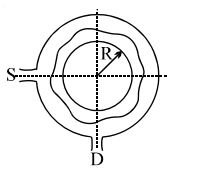
$Reason :$ As the temperature increses, the velocity of sound increases more rapidly than length of the pipe. - 7A narrow tube is bent in the form of a circle of radius $R,$ as shown in the figure. Two small holes $S$ and $D$ are made in the tube at the positions right angle to each other. A source placed at $S$ generated a wave of intensity $I_0$ which is equally divided into two parts : One part travels along the longer path, while the other travels along the shorter path. Both the part waves meet at the point $D$ where a detector is placed The maximum value of $\lambda$ to produce a maxima at $D$ is given byView Solution
- 8A rope of length $L$ and mass $M$ hangs freely from the ceiling. If the time taken by a transverse wave to travel from the bottom to the top of the rope is $T$, then time to cover first half length isView Solution
- 9The equation $\overrightarrow {\phi \,} (x,\,t) = \overrightarrow {j\,} \sin \,\left( {\frac{{2\pi }}{\lambda }v\,t} \right)\cos \,\left( {\frac{{2\pi }}{\lambda }x} \right)$ representsView Solution
- 10View SolutionThe Doppler's effect is applicable for