Question
An electric dipole placed in a non-uniform electric field can experience

Answer

(a) always a force and a torque.
Explanation: always a force and a torque.

Need a full question paper?

Generate a complete, print-ready paper with questions like this in minutes — across 16+ boards, with answer keys.
Start Generating Free

Similar questions

A symmetric double convex lens is cut in two equal parts by a plane perpendicular to the principal axis. If the power of the original lens was $4D,$ the power of a cutlens will be$:$
An electric dipole is placed in an electric field generated by a point charge(a) The net electric force on the dipole must be zero(b) The net electric force on the dipole may be zero(c) The torque on the dipole due to the field must be zero(d) The torque on the dipole due to the field may be zero


Two important processes that occur during the formation of a p-n junction.
The sun radiates energy in all directions. The average radiations received on the earth surface from the sun is $1.4$ kilowatt $/ \mathrm{m}^2$.The average earth $-$ sun distance is $1.5 \times 10^{11}$ metres. The mass lost by the sun per day is $(1$ day $= 86400$ seconds$)$
The frequency and intensity of a light source are both doubled. Consider the following statements.
  1. The saturation photocurrent remains almost the same.
  2. The maximum kinetic energy of the photoelectrons is doubled.
A charge $q$ coulomb moves in a circle at n revolutions per second and the radius of the circle is $r$ metre. Then magnetic field at the centre of the circle is
There is 10 units of charge at the centre of a circle of radius 10m. The work done in moving 1 unit of charge around the circle once is (a) Zero  (b) 10 units(c) 100 units(d) 1 unit
       
Refractive index of diamond Is :
Assertion :   A paramagnetic sample display greater magnetisation (for the same magnetising field) when cooled.
Reason     : The magnetisation does not depend on temperature.(a) If both assertion and reason are true and the reason is the correct explanation of the assertion.(b) If both assertion and reason are true but reason is not the correct explanation of the assertion.(c) If assertion is true but reason is false.(d) If the assertion and reason both are false.


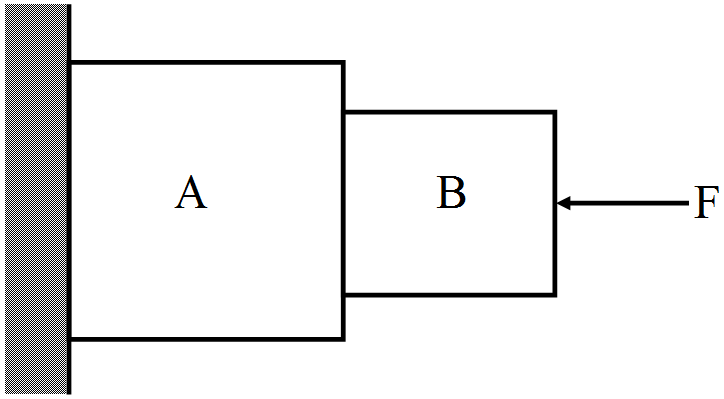
Consider the situation shown in figure. The wall smooth but the surface of A and B in contact are rough. The friction on B due to A in equilibrium:
  1. Is upward.
  2. Is downward.
  3. Is zero.
  4. The system cannot remain in equilibrium.