MCQ
An electric dipole when placed in a uniform electric field $E$ will have minimum potential energy, when the angle made by dipole moment with field $E$ is
  • A
    $\pi$
  • B
    $\frac{3 \pi}{2}$
  • Zero
  • D
    $\frac{\pi}{2}$

Answer

Correct option: C.
Zero
c
(c)

$U=-p E \cos \theta$

For $U_{\min } \theta=0^{\circ}$ So, $U_{\min }=-p E$

Need a full question paper?

Generate a complete, print-ready paper with questions like this in minutes — across 16+ boards, with answer keys.

Start Generating Free

Similar questions

A hydraulic press containing water has two arms with diameters as mentioned in the figure. A force of $10 \mathrm{~N}$ is applied on the surface of water in the thinner arm. The force required to be applied on the surface of water in the thicker arm to maintain equilibrium of water is_________.${N}$.
A metal block is exposed to beams of $X-$ ray of different wavelength. $X-$ rays of which wavelength penetrate most.......$\mathop A\limits^o $
When two sound sources of the same amplitude but of slightly different frequencies $v_1$ and $v_2$ are sounded simultaneously, the sound one hears has a frequency equal to
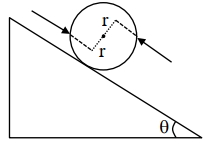
A solid sphere of mass $1 kg$ and radius $1 m$ rolls without slipping on a fixed inclined plane with an angle of inclination $\theta=30^{\circ}$ from the horizontal. Two forces of magnitude $1 N$ each, parallel to the incline, act on the sphere, both at distance $r=0.5 m$ from the center of the sphere, as shown in the figure. The acceleration of the sphere down the plane is. . . . $m s^{-2}$. (Take $g=10 ms ^{-2}$.)
A uniform magnetic field of 0.4 T acts perpendicular to a circular copper disc 20 cm in radius. The disc is having a uniform angular velocity of $10 \pi \mathrm{rad} \mathrm{s}^{-1}$ about an axis through its centre and perpendicular to the disc. What is the protential difference developed between the axis of the disc and the rim ? $(\pi=3.14)$
The plane faces of two identical plano-convex lenses each having focal length of $40 cm$ are pressed against each other to form a usual convex lens. The distance from this lens, at which an object must be placed to obtain a real, inverted image with magnification one is.......$cm$
If two rods of length $L$ and $2L$ having coefficients of linear expansion $\alpha$ and $2\alpha$ respectively are connected so that total length becomes $3L$, the average coefficient of linear expansion of the composition rod equals:
A solid cylinder of mass $2\; kg$ and radius $4 \;\mathrm{cm}$ is rotating about its axis at the rate of $3\; \mathrm{rpm}$. The torque required to stop after $2 \pi$ revolutions is
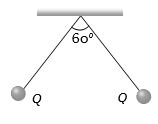
Two small spherical balls each carrying a charge $Q = 10\,\mu C$ ($10$ micro-coulomb) are suspended by two insulating threads of equal lengths $1\,m$ each, from a point fixed in the ceiling. It is found that in equilibrium threads are separated by an angle ${60^o}$ between them, as shown in the figure. What is the tension in the threads......$N$ (Given: $\frac{1}{{(4\pi {\varepsilon _0})}} = 9 \times {10^9}\,Nm/{C^2}$)
A particle moves in the $X-Y$ plane under the influence of a force such that its linear momentum is $\overrightarrow{\mathrm{p}}(t)=A[\hat{\mathrm{i}} \cos (\mathrm{kt})-\hat{\mathrm{j}} \sin (\mathrm{kt})]$, where $A$ and $k$ are constants. The angle between the force and the momentum is