An electric fan and a heater are marked as $100\, watt$, $220\, volt$ and $1000\, watt$, $220\, volt$ respectively. The resistance of the heater is
Easy


Download our appand get started for free
Experience the future of education. Simply download our apps or reach out to us for more information. Let's shape the future of learning together!No signup needed.*
Similar Questions
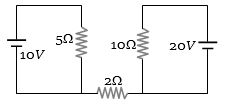
- 1Find out the value of current through $2\,\Omega$ resistance for the given circuit ............ $A$View Solution
- 2On giving $220\,V$ to a resistor the power dissipated is $40\,W$ then value of resistance is ............... $\Omega$View Solution
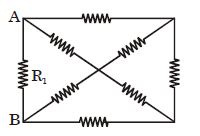
- 3As shown, the circuit is made of $8$ different resistors. It is found that when $R_1 = 4\,\,\Omega,$ the resistance between $A$ and $B$ is $2\,\,\Omega.$ Now replace $R_1$ by a $6\,\,\Omega$ resistor, what is the resistance between $A$ and $B$?View Solution
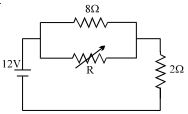
- 4The value of the resistance $R$ in figure is adjusted such that power dissipated in the $2\,\Omega$ resistor is maximum. Under this conditionView Solution
- 5A $50\,V$ battery is connected across a $10\, ohm$ resistor. The current is $4.5\, amperes$. The internal resistance of the battery is ............. $ohm$View Solution
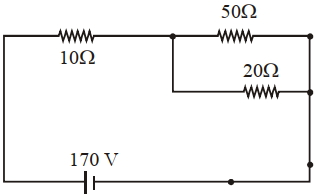
- 6The voltage across the $10\, \Omega$ resistor in the given circuit is $x$ volt.View Solution
The value of $'x'$ to the nearest integer is..........
- 7Two resistances of $400\,\Omega $ and $800\,\Omega $ are connected in series with a $6\,volt $ battery of negligible internal resistance. A voltmeter of resistance $10,000\,\Omega $ is used to measure the potential difference across $400\,\Omega $ . The error in the measurement of potential difference (in volt) approximately isView Solution
- 8Water of volume $2\, litre$ in a container is heated with a coil of $1\, kW$ at $27 \,^oC$. The lid of the container is open and energy dissipates at rate of $160\, J/s$. In how much time temperature will rise from $27\,^oC$ to $77\,^oC$ $[$ Given specific heat of water is $4.2\, kJ/kg$ $]$View Solution
- 9A parallel combination of two resistors, of $1 \,\Omega$ each, is connected in series with a $1.5 \,\Omega$ resistor. The total combination is connected across a $10\, V$ battery. The current flowing in the circuit is .............. $A$View Solution
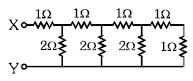
- 10Net resistance of the given circuit between $X$ and $Y$ is ............... $\Omega$View Solution