Question
An electric heating element in vacuum is surrounded by a cavity at constant temperature of 227ºC; it consumes 60W of power to maintain a temperature of 727ºC. What is the power consumed by the element to maintain a temperature of 1227º C?

Answer

  1. 320W.

Need a full question paper?

Generate a complete, print-ready paper with questions like this in minutes — across 16+ boards, with answer keys.
Start Generating Free

Similar questions

Critical angle is that angle of incidence in the denser medium for which the angle of refraction in rarer medium is(a) 0° (b) 57°(c) 90°(d) 180°
       
Which of the following relation is significant for metals when the temperature increases?
A $1 \mu \mathrm{A}$ beam of protons with a cross$-$sectional area of $0.5 \ \mathrm{sq} . \mathrm{mm}$ is moving with a velocity of $3 \times 10^4 \mathrm{~ms}^{-1}.$ Then charge density of beam is
Two coherent sources whose frequency ratio is $100: 1$ used to generate interference fringes. The ratio of maximum and minimum intensity in fringes will be :
The energy liberated on complete fission of $1 \ kg$ of $92^{\mathrm{U}^{285}}$ is (Assume 200 MeV energy is liberated on fission of $1$ nucleus$)$
When a current passes through a wire whose different parts are maintained at different temperatures, evolution or absorption of heat all along the length of wire is known as(a) Joule effect(b) Seebeck effect(c) Peltier effect(d) Thomson effect
       
The ionization energy of hydrogen atom is 13.6eV. Following Bohr’s theory, the energy corresponding to a transition between 3rd and 4th orbit is:
Consider the two following statements A and B and identify the correct choice given in the answers;
(A) In photovlotaic cells the photoelectric current produced is not proportional to the, intensity of incident light.
(B) In gas filled photoemissive cells, the velocity of photoelectrons depends on the wavelength of the incident radiation.(a) Both A and B are true(b) Both A and B are false(c) A is true but B is false(d) A is false B is true
   
   
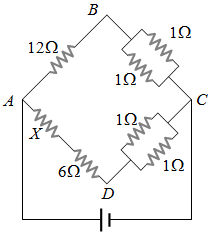
For what value of unknown resistance $X,$ the potential difference between $B$ and $D$ will be zero in the circuit shown in the figure
How many quantities are required to specify the magnetic field of the earth?