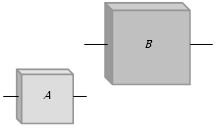
An electric kettle has two heating coils. When one coil is used, water in the kettle boils in $5$ minutes, while when second coil is used, same water boils in $10\,\min$. If the two coils, connected in parallel are used simultaneously, the same water will boil in time
Medium
Download our app for free and get started
(a) In parallel $\frac{1}{{{t_p}}} = \frac{1}{{{t_1}}} + \frac{1}{{{t_2}}}$$ \Rightarrow $ ${t_p} = \frac{{{t_1}{t_2}}}{{{t_1} + {t_2}}}$
$ = \frac{{5 \times 10}}{{5 + 10}} = \frac{{50}}{{15}} = 3.33\,\min $$ = 3\,\min.\,20\,sec$

Download our appand get started for free
Experience the future of education. Simply download our apps or reach out to us for more information. Let's shape the future of learning together!No signup needed.*
Similar Questions
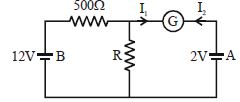
- 1In the adjoining circuit, the galvanometer $G$ shows zero deflection. If the batteries $A$ and $B$ have negligible internal resistance, the value of the resistor $R$ will be .............. $\Omega$View Solution
- 2Resistors of $1$, $2$, $ohm$ are connected in the form of a triangle. If a $1.5\, volt$ cell of negligible internal resistance is connected across $3\, ohm$ resistor, the current flowing through this resistance will be ................ $amp$View Solution
- 3The resistance of an electrical toaster has a temperature dependence given by $R\left( T \right) = {R_0}\left[ {1 + \alpha \left( {T - {T_0}} \right)} \right]$ in its range of operation. At ${T_0} = 300\,K,R = 100\,\Omega $ and at $T = 500\,K,\,R = 120\,\Omega $. The toaster is connected to a voltage source at $200\, V$ and its temperature is raised at a constant rate from $300$ to $500\, K$ in $30\, s$. The total work done in raising the temperature isView Solution
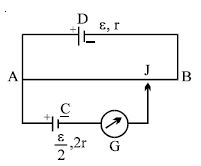
- 4In the figure, the potentiometer wire $AB$ of length $L$ and resistance $9r$ is joined to the cell $D$ of $\mathrm{emf}$ $\varepsilon$ and internal resistance $r$. The cell $C’s$ $\mathrm{emf}$ is $\varepsilon /2$ and its internal resistance is $2r$. The galvanometer $G$ will show no deflection when the length $AJ$ isView Solution
- 5View SolutionThe reciprocal of resistance is
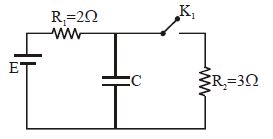
- 6In the circuit shown in the figure $K_1$ is open. The charge on capacitor $C$ in steady state is $q_1$. Now key is closed and at steady state charge on $C$ is $q_2$. The ratio of charges $q_1/q_2$ isView Solution
- 7A wire when connected to $220\,V$ mains supply has power dissipation ${P_1}$. Now the wire is cut into two equal pieces which are connected in parallel to the same supply. Power dissipation in this case is ${P_2}$. Then ${P_2}:{P_1}$ isView Solution
- 8A rise of temperature of $4\,^oC$ is observed in a conductor by passing a current. If the current is tripled, the rise temperature will be .............. $^oC$View Solution
- 9For what value of $R$ the net resistance of the circuit will be $18\, ohms$ ............... $\Omega$View Solution
- 10$A$ and $B$ are two square plates of same metal and same thickness but length of $B$ is twice that of $A$. Ratio of resistances of $A$ and $B$ isView Solution