MCQ
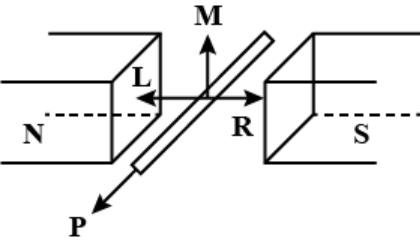
An electric potential difference will be induced between the ends of the conductor shown in the figure, if the conductor moves in the direction shown by:
Image
  • A
    $P$
  • B
    $R$
  • C
    $L$
  • $M$

Answer

Correct option: D.
$M$

Fleming’s Right Hand Rule gives the direction of current in the conductor whenever it is moved in any magnetic field. It states that if we stretch our right hand fingers perpendicular to each other as shown in fig, then if fore finger is in the direction of Magnetic field and thumb is in the direction of motion of conductor then middle finger gives the direction of current in the conductor.
Explanation for the correct answer:
For induction of emf in the conductor, the motion of conductor should be perpendicular to the direction of magnetic field. Thus, Option $B$ and $C$ are eliminated.
Now if we move conductor in $P$ direction, the motion will be perpendicular to the direction of magnetic field but then the charge separation in the conductor will take place perpendicular to the length of the conductor. Thus, due to less space for charge separation emf can not be induced in the conductor. Thus, Option A is eliminated.
If conductor is moved in direction $M$ then the charge separation in the conductor takes place across its length, there will be enough space for charge separation. And thus emf will be induced across the conductor.

Need a full question paper?

Generate a complete, print-ready paper with questions like this in minutes — across 16+ boards, with answer keys.
Start Generating Free

Similar questions

The heat produced by a 100 watt heater in 2 minute will be equal to
Atom bomb consists of two pieces of $92^{\mathrm{U}^{285}}$ and a source of
Radioactivity is:
As the intensity of incident light increases
If current in an electric bulb changes by $1\%$, then the power will change by ............ $\%$
A ray of light is incident on a thick slab of glass of thickness $t$ as shown in the figure.  The  emergent ray is parallel to the incident ray but displaced sideways by a distance $d$. If  the angles are small then $d$ is
Between the plates of a parallel plate capacitor a dielectric plate is introduced just to fill the space between the plates. The capacitor is charged and later disconnected from the battery. The dielectric plate is slowly drawn out of the capacitor parallel to the plates. The plot of the potential difference across the plates and the length of the dielectric plate drawn out is
If the coefficient of mutual induction of the primary and secondary coils of an induction coil is $5\, H$ and a current of $10\, A$ is cut off in $5\times10^{-4}\, s$, the $emf$ inducted (in $volt$) in the secondary coil is
A combination of two thin lenses with focal lengths ${f_1}$ and ${f_2}$ respectively forms an image of distant object at distance $60 cm$ when lenses are in contact. The position of this image shifts by $30 cm$ towards the combination when two lenses are separated by $10 cm.$ The corresponding values of ${f_1}$ and ${f_2}$ are
There is an equiconvex glass lens with radius of each face as $R$ and $_a{\mu _g} = 3/2$ and $_a{\mu _w} = 4/3$. If there is water in object space and air in image space, then the focal length is