MCQ
An electromagnetic wave going through vacuum is described by $\text{E}=\text{E}_0\sin(\text{kx}-\omega\text{t})$ which of the following is/are independent of the wavelength?
  • A
    $\text{k}$
  • B
    $\omega$
  • $\frac{\text{k}}{\omega}$
  • D
    $\text{k}\omega$

Answer

Correct option: C.
$\frac{\text{k}}{\omega}$
The given quantities can be expressed as,
k is given by,
$\omega$ is given by,
$\omega=2\pi\text{v}$
$\text{c}=\text{v}\lambda$
$\omega=2\pi\frac{\text{c}}{\lambda}$
$\frac{\text{k}}{\omega}$ is given by,
$\frac{\text{k}}{\omega}=\frac{\frac{2\pi}{\lambda}}{\frac{2\pi\text{c}}{\lambda}}=\frac{1}{\text{c}}$
$\text{k}\omega$ is given by,
$\text{k}\times\omega=\frac{2\pi}{\lambda}\times\frac{2\pi\text{c}}{\lambda}=\frac{4\pi^2\text{c}}{\lambda^2}$
Thus, $\frac{\text{k}}{\omega}$ is independent of the wavelength.

Need a full question paper?

Generate a complete, print-ready paper with questions like this in minutes — across 16+ boards, with answer keys.
Start Generating Free

Similar questions

The maximum velocity of a simple harmonic motion represented by $y = 3\sin \,\left( {100\,t + \frac{\pi }{6}} \right)$is given by
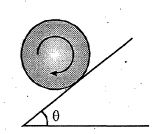
A hollow cylinder of mass $m$ and radius $R$ is  spinned to a clockwise angular velocity ${\omega _0}$ and then gently placed on an inclined plane for which coeffiient of friction $μ = tan\theta ,\theta $ is the angle of inclined plane with horizontal. The centre of mass of the cylinder will remain stationary for time
A hall has the dimensions $10\,m \times 12\,m \times 14\,m.$A fly starting at one corner ends up at a diametrically opposite corner. What is the magnitude of its displacement...........$m$
The mass of moon is $7.34 \times {10^{22}}\,kg$ and radius of moon is $1.74 \times {10^6}\,m$ then The value of gravitation accelaration will be ....... $N/kg$
If momentum $[ P ]$, area $[ A ]$ and time $[ T ]$ are taken as fundamental quantities, then the dimensional formula for coefficient of viscosity is :
Consider a system of two identical particles. One of the particles is at rest and the other has an acceleration $\overrightarrow{\text{a}}.$ The centre of mass has an acceleration:
A particle of mass m is hanging vertically by an ideal spring of force constant K. If the mass is made to oscillate vertically, its total energy is
At which of the following temperatures the value of surface tension of water is minimum?
Find the amount of work done to increase the temperature of one mole of an ideal gas by $30^o\ C$ if it is expanding under the condition  .... $J$

$V\propto {T^{\frac{2}{3}}}$ $[R = 1.99\  cal/mol-K]$
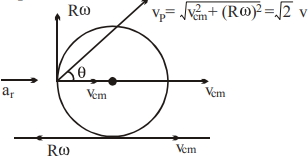
$A$ disc of radius $R$ is rolling purely on a flat horizontal surface, with a constant angular velocity. The angle between the velocity and acceleration vectors of point $P$ is