MCQ
An electromagnetic wave going through vacuum is described by $\text{E}=\text{E}_0\sin(\text{kx}-\omega\text{t}),\text{ B}=\text{B}_0\sin(\text{kx}-\omega\text{t})$ Then:
  • $\text{E}_0\text{k}=\text{B}_0\omega$
  • B
    $\text{E}_0\text{B}_0=\omega\text{k}$
  • C
    $\text{E}_0\omega=\text{B}_0\text{k}$
  • D
    None of these.

Answer

Correct option: A.
$\text{E}_0\text{k}=\text{B}_0\omega$
The relation between $E_0$ and $B_0$ id given by $\frac{\text{E}_0}{\text{B}_0}=\text{c}\ ....(\text{i})$
Here, $c =$ Speed of the electromagnetic wave,
The relation between $\omega ($the angular frequency$)$ and $k($wave number$)$,
$\frac{\omega}{\text{k}}=\text{c}\ ...(\text{ii})$
Therefore, from $(i)$ and $(ii),$ we get
$\frac{\text{E}_0}{\text{B}_0}=\frac{\omega}{\text{k}}=\text{c}$
$\text{E}_0\text{k}=\text{B}_0\omega$

Need a full question paper?

Generate a complete, print-ready paper with questions like this in minutes — across 16+ boards, with answer keys.

Start Generating Free

Similar questions

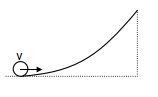
A small object of uniform density rolls up a curved surface with an initial velocity $v$. It reaches up to a maximum height of $\frac{3 \mathrm{v}^2}{4 \mathrm{~g}}$ with respect to the initial position. The object is
A particle moves along $x$-axis in such a way that its $x$-co-ordinate varies with time according to the equation $x=4-2 t+t^2$. The speed of the particle will vary with time as
A gas is collected over the water at $25°C.$ The total pressure of moist gas was $735 \,mm$ of mercury. If the aqueous vapour pressure at $25°C$ is $23.8\, mm.$ Then the pressure of dry gas is..... $mm$
When sound travels from air to water, which parameter does not change?
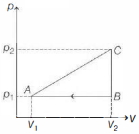
An ideal gas with constant heat capacity $C_V=\frac{3}{2} n R$ is made to carry out a cycle that is depicted by a triangle in the figure given below. The following statement is true about the cycle.
Given below are two statements:

Statement $I:$ A truck and a car moving with same kinetic energy are brought to rest by applying brakes which provide equal retarding forces. Both come to rest in equal distance.

Statement $II:$ A car moving towards east takes a turn and moves towards north, the speed remains unchanged. The acceleration of the car is zero.

In the light of given statements, choose the most appropriate answer from the options given below.

Water rises in a capillary tube to a certain height such that the upward force due to surface tension is balanced by $75 \times {10^{ - 4}}\,N$ force due to the weight of the liquid. If the surface tension of water is $6 \times {10^{ - 2}}\,N{m^{ - 1}}$, the inner circumference of the capillary must be
Three identical thin rods each of length $l$ and mass $M $ are joined together to form a letter $H.$ What is the moment of inertia of the system about one of the sides of $H$
Who gave the law of equipartition of energy?
In the given progressive wave equation, what is the maximum velocity of particle $Y = 0.5\sin (10\pi t - 5x) cm$