MCQ
An electromagnetic wave, going through vacuum is described by $\text{E}=\text{E}_0\sin(\text{kx}-\omega\text{t}.)$ Which of the following is independent of wavelength?
  • A
    $\text{k}$
  • B
    $\omega$
  • $\frac{\text{k}}{\omega}$
  • D
    $\text{k}\omega$

Answer

Correct option: C.
$\frac{\text{k}}{\omega}$

$\text{k}=\frac{2\pi}{\lambda}$
$\omega=\frac{2\pi\text{c}}{\lambda},$ where c is the velocity of light
Hence, $=\frac{\text{k}}{2\pi}=\frac{\omega}{2\pi\text{c}}$
$\Rightarrow\frac{\text{k}}{\omega}$ is independent of the wavelength.

Need a full question paper?

Generate a complete, print-ready paper with questions like this in minutes — across 16+ boards, with answer keys.
Start Generating Free

Similar questions

A student is provided with a variable voltage source $V$, a test resistor $R_T=10\,\Omega$, two identical galvanometers $G_1$ and $G_2$ and two additional resistors, $R _1=10\,M\,\Omega$ and $R _2=0.001\,\Omega$. For conducting an experiment to verify ohms law, the most suitable circuit is:
A charge $Q$ is uniformly distributed over a large plastic plate. The electric field at a point $P$ close to the centre of the plate is $10 Vm ^{-1}$. If the plastic plate is replaced by a copper plate of the same geometrical dimensions and carrying the same charge $Q$, the electric field at the point $P$ will become:
If a carrier wave $C\left( t \right) = A\,\sin \,{\omega _c}t$ is amplitude modulated by a modulator signal $m\left( t \right) = A\,\sin \,{\omega _m}t$ then the equation of modulated signal $[C_m(t)]$ and its modulation index are respectively
N-type semiconductors will be obtained, when germanium is doped with
If $x$ is the distance of an object from the focus of a concave mirror and $y$ is the distance of image from the focus, then which of the following graphs is correct between $x$ and $y$
The wavelength of de-Broglie wave is $2\mu m$, then its momentum is ($h = 6.63 ×10^{-34} J-s$)
An electric field of $1000\,V/m$ is applied to an electric dipole at angle of $45^o$. The value of electric dipole moment is $10^{-29}\, C.m.$ What is the potential energy of the electric dipole?
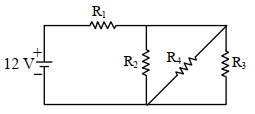
In the given figure $R_1=10 \Omega, R_2=8 \Omega, R_3=4 \Omega$ and $R_4=8 \Omega$. Battery is ideal with emf $12 \mathrm{~V}$. Equivalent resistant of the circuit and current supplied by battery are respectively.
The de-Broglie wavelength of a particle moving with a velocity $2.25 \times 10^8 \,m/s $ is equal to the wavelength of photon. The ratio of kinetic energy of the particle to the energy of the photon is (velocity of light is $3 \times 10^8 \,m/s$) :-
An electric current is passed through a circuit containing two wires of the same material, connected in parallel. If the lengths and radii of the wires are in the ratio of $4/3$ and $2/3$, then the ratio of the currents passing through the wire will be