MCQ
An electron and a proton are moving on straight parallel paths with same velocity. They enter a semi-infinite region of uniform magnetic field perpendicular to the velocity. Which of the following statement$(s)$ is/are true?

$(A)$ They will never come out of the magnetic field region.

$(B)$ They will come out travelling along parallel paths.

$(C)$ They will come out at the same time.

$(D)$ They will come out at different times.

  • $(BC, BD, BCD)$
  • B
    $(BC, AD, ACD)$
  • C
    $(AB, BD, ABD)$
  • D
    $(AD, BC, ABD)$

Answer

Correct option: A.
$(BC, BD, BCD)$
a

Need a full question paper?

Generate a complete, print-ready paper with questions like this in minutes — across 16+ boards, with answer keys.

Start Generating Free

Similar questions

A dipole with an electric moment $\vec{p}$ is located at a distance $r$ from a long thread charged uniformly with a linear charge density $\lambda$. Find the force $F$ acting on the dipole if the vector $\vec{p}$ is oriented along the thread
In case of damped oscillation frequency of oscillation is ............
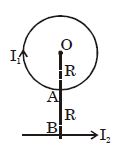
In the diagram, $I_1$ , $I_2$ are the strength of the currents in the loop and infinite long straight conductor respectively. $OA = AB = R$ . The net magnetic field at the centre $O$ is zero. Then the ratio of the currents in the loop and the straight conductor is 
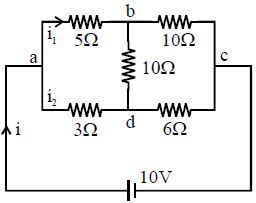
Find current through the branch $ad$ of the circuit shown in figure. :-............. $A$
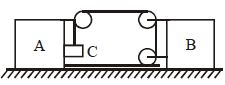
If the block $A$ & $B$ are moving towards each other with acceleration $a$ and $b$. Find the net acceleration of $C$.
Two particles of equal mass $\mathrm{m}$ have respective initial velocities $u\hat{i}$ and $u\left(\frac{\hat{\mathrm{i}}+ \hat{\mathrm{j}}}{2}\right) .$ They collide completely inelastically. The energy lost in the process is
Average density of the earth 
The value of $g $ at a place decreases by $ 2\%.$ The barometric height of mercury
The area of cross-section of a large tank is $0.5 \; m ^{2}$. It has a narrow opening near the bottom having area of cross-section $1 \; cm ^{2}$. A load of $25 \; kg$ is applied on the water at the top in the tank. Neglecting the speed of water in the tank, the velocity of the water, coming out of the opening at the time when the height of water level in the tank is $40 \; cm$ above the bottom, will be $\dots \; cms ^{-1}$. $\left[\right.$ Take $\left.g =10 \; ms ^{-2}\right]$
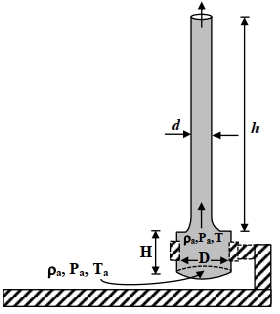
A cylindrical furnace has height $(H)$ and diameter $(D)$ both $1 \mathrm{~m}$. It is maintained at temperature $360 \mathrm{~K}$. The air gets heated inside the furnace at constant pressure $P_a$ and its temperature becomes $T=360 \mathrm{~K}$. The hot air with density $\rho$ rises up a vertical chimney of diameter $d=0.1 \mathrm{~m}$ and height $h=9 \mathrm{~m}$ above the furnace and exits the chimney (see the figure). As a result, atmospheric air of density $\rho_a=1.2 \mathrm{~kg} \mathrm{~m}^{-3}$, pressure $P_a$ and temperature $T_a=300 \mathrm{~K}$ enters the furnace. Assume air as an ideal gas, neglect the variations in $\rho$ and $T$ inside the chimney and the furnace. Also ignore the viscous effects.

[Given: The acceleration due to gravity $g=10 \mathrm{~ms}^{-2}$ and $\pi=3.14$ ]

(image)

($1$) Considering the air flow to be streamline, the steady mass flow rate of air exiting the chimney is

. . . . .$\mathrm{gm} \mathrm{s}^{-1}$.

($2$) When the chimney is closed using a cap at the top, a pressure difference $\Delta P$ develops between the top and the bottom surfaces of the cap. If the changes in the temperature and density of the hot air, due to the stoppage of air flow, are negligible then the value of $\Delta P$ is. . . . .$\mathrm{Nm}^{-2}$.