MCQ
An electron and a proton enter a magnetic field perpendicularly. Both have same kinetic energy. Which of the following is true
  • A
    Trajectory of electron is less curved
  • Trajectory of proton is less curved
  • C
    Both trajectories are equally curved
  • D
    Both move on straight-line path

Answer

Correct option: B.
Trajectory of proton is less curved
 Trajectory of proton is less curved

Need a full question paper?

Generate a complete, print-ready paper with questions like this in minutes — across 16+ boards, with answer keys.

Start Generating Free

Similar questions

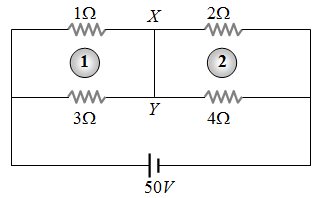
Current through wire XY of circuit shown is
The work done against electrostatic force gets stored in which form of energy?
One end of a uniform rod of mass m and length (l) is clamped. The rod lies on a smooth horizontal surface and rotates on it about the clamped end at a uniform angular velocity $\omega.$ The force exerted by the clamp on the rod has a horizontal component:
Two resistors of resistance $R_1$ and $R_2$ having $R_1 > R_2$ are connected in parallel. For equivalent resistance $R$, the correct statements is
Match the List $I$ with List $II$

LIST $I$ LIST $II$
$A$ Intrinsic Semiconductor $I$ Fermi-level near conduction band
$B$ $n-$type semiconductor $II$ Fermi-level at middle
$C$ $p-$ type semiconductor $III$ Fermi-level near valence band
$D$ Metals $IV$ Fermi-level inside conduction band

Choose the correct answer from the options given below:

Laser beams are used to measure long distances because
In $p-$ type semiconductor, the major charge carriers are
The count rate of a Geiger- Muller counter for the radiation of a radioactive material of half life of $30\, minutes$ decreases to $5\,{s^{ - 1}}$ after $2\, hours.$ The initial count rate was..........${s^{ - 1}}$
n equal resistors are first connected in series and then connected in parallel. What is the ratio of the maximum to the minimum resistance
The charge on a particle Y is double the charge on particle X. These two particles X and Y after being accelerated through the same potential difference enter a region of uniform magnetic field and describe circular paths of radii $R_1$ and $R_2$ respectively. The ratio of the mass of X to that of Y is