Question
An electron and photon have same energy 100eV. Which has greater associated wavelength?

Answer

De-Broglie wavelength associated with electron, $\lambda_\text{e}=\frac{\text{h}}{\sqrt{2\text{mE}_\text{e}}}\Rightarrow\ \text{E}_\text{}e=\frac{\text{h}^2}{2\text{m}\lambda^2_\text{e}}\dots(\text{i})$ Also wavelength of photon of energy $E_{ph}$​​​​​​​ is,$\text{E}_\text{ph}=\frac{\text{hc}}{\lambda_{\text{ph}}}\Rightarrow\ \text{E}^2_{\text{ph}}=\frac{\text{h}^2\text{c}^2}{\lambda^2_\text{ph}}\dots(\text{ii})$
Given $E_e = E_{ph} = E (say) = 100eV$ Dividing (ii) by (i) and using (iii), we get $\text{E}=\frac{\frac{\text{h}^2\text{c}^2}{\lambda^2_\text{ph}}}{\frac{\text{h}^2}{2\text{m}\lambda^2_\text{e}}}$ or $\text{E}=\frac{2\text{mc}^2\lambda^2_\text{e}}{\lambda^2_{\text{ph}}}$ $\therefore\ \frac{\lambda_\text{e}}{\lambda_{\text{ph}}}=\sqrt{\frac{\text{E}}{2\text{mc}^2}}$ As $\text{E}=100\text{eV } 2\text{mc}^2\cong1\text{MeV}$ $\therefore\ \text{E}<<2\text{mc}^2\Rightarrow\ \lambda_\text{e}<\lambda_\text{ph}$ That is, wavelength associated with photon is greater as compared to electron of same energy.

Need a full question paper?

Generate a complete, print-ready paper with questions like this in minutes — across 16+ boards, with answer keys.
Start Generating Free

Similar questions

A compass needle free to turn in a horizontal plane is placed at the centre of circular coil of 30 turns and radius 12 cm. The coil is in a vertical plane making an angle of 45° with the magnetic meridian. When the current in the coil is 0.35 A, the needle points west to east.
  1. Determine the horizontal component of the earth’s magnetic field at the location.
  2. The current in the coil is reversed, and the coil is rotated about its vertical axis by an angle of 90° in the anticlockwise sense looking from above. Predict the direction of the needle. Take the magnetic declination at the places to be zero.
Is there any meaning of "Weight of the earth"?
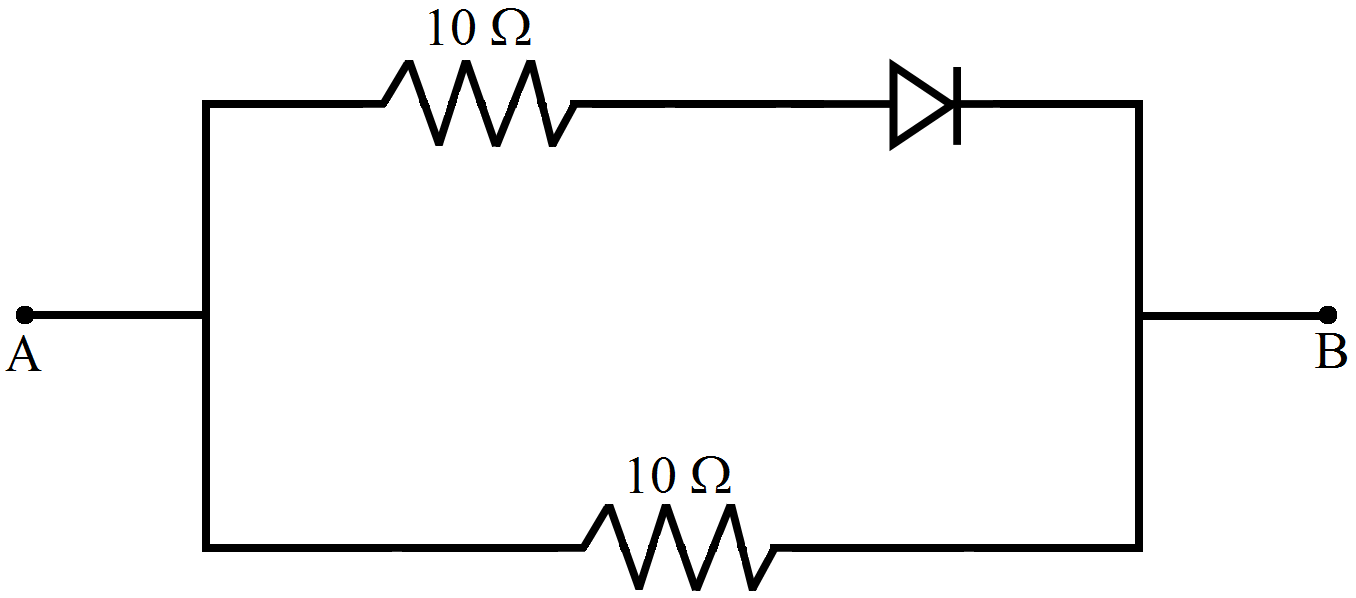
Find the equivalent resistance of the network shown in figure. between the points A and B.
A free atom of iron emits $\text{K}_\alpha$ X-rays of energy 6.4keV. Calculate the recoil kinetic energy of the atom. Mass of an iron atom $= 9.3 \times 10^-^{26}kg.$
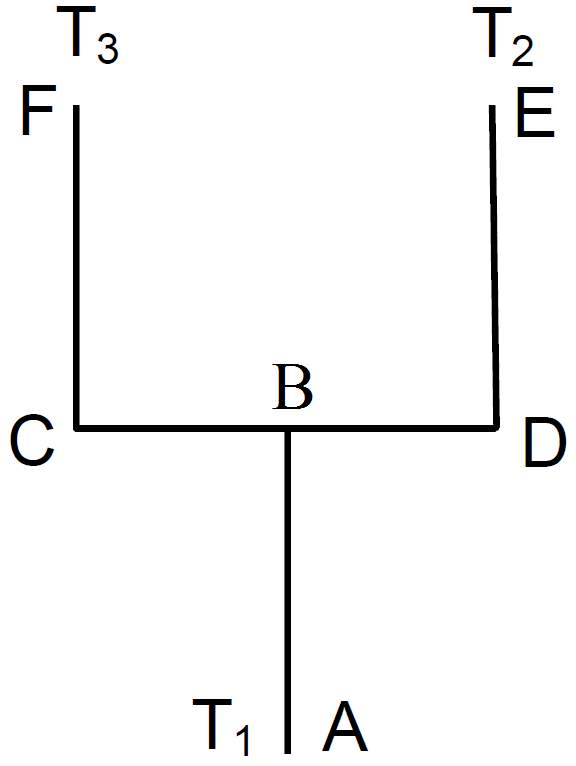
Four identical rods AB, CD, CF and DE are joined as shown in figure. The length, cross-sectional area and thermal conductivity of each rod are l, A and K respectively. The ends A, E and F are maintained at temperatures $T_1, T_2$ and $T_3$ respectively. Assuming no loss of heat to the atmosphere, find the temperature at B.
  1. In Young's double slit experiment, two slits are 1 mm apart, and the screen is placed 1 m away from the slits. Calculate the fringe width when light of wavelength 500 nm is used.
  2. What should be the width of each slit in order to obtain 10 maxima of the double slits pattern within the central maximum of the single slit pattern?
State Kirchhoff's laws and explain them by giving examples.###Explain that first law of Kirchhoff is equivalent to law of conservation of charge and the second law is a descriptive form of Ohm's law.###For a current carrying conductor, write Kirchhoff's laws of charge and energy conservation.
Get the electric field due to a uniformly charged infinite plane sheet.
A beam of light converges to a point P. A lens is placed in the path of the convergent beam12 cm from P. At what point does the beam converge if the lens is.
  1. a convex lens of focal length 20 cm,
  2. a concave lens of focal length 16 cm?
Do the required calculations.
A traffic policeman standing on a road sounds a whistle emitting the main frequency of 2.00kHz. What could be the appparent frequency heard by a scooter-driver approaching the policeman at a speed of 36.0km/h? Speed of sound in air = 340m/s.