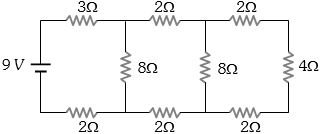
An electron (charge $= 1.6 × 10^{-19}$ coulomb) is moving in a circle of radius $5.1 × 10^{-11}\,m$ at a frequency of $6.8 × 10^{15} $ revolutions/sec. The equivalent current is approximately
Easy
Download our app for free and get started
(c) $i = e\nu = 1.6 \times {10^{ - 19}} \times 6.8 \times {10^{15}} = 1.1 \times {10^{ - 3}}\,amp$

Download our appand get started for free
Experience the future of education. Simply download our apps or reach out to us for more information. Let's shape the future of learning together!No signup needed.*
Similar Questions
- 1A potentiometer wire has length $4\,\, m$ and resistance $8\,\,\Omega $. The resistance that must be connected in series with the wire and an accumulator of e.m.f. $2\,\, V,$ so as to get a potential gradient $1\,\, m \,V$ per $cm$ on the wire is ............. $\Omega$View Solution
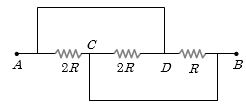
- 2What is the equivalent resistance between $A$ and $B$View Solution
- 3View SolutionIf an observer is moving with respect to a stationary electron, then he observes
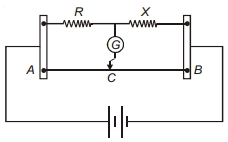
- 4In the meter bridge shown, the resistance $X$ has a negative temperature coefficient of resistance. Neglecting the variation in other resistors, when current is passed for some time, in the cirucit, balance point should shift towards.View Solution
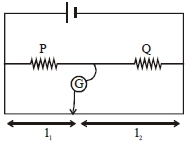
- 5The meter bridge shown is in balanced position with $\frac{\mathrm{P}}{\mathrm{Q}}=\frac{\mathrm{l}_{1}}{\mathrm{l}_{2}}$. If we now litterchange the positions of gavanometer and cell, will the bridge work? If yes, what will be balance condition?View Solution
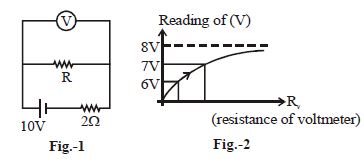
- 6In the given figure $-1$, resistance of shown voltmeter is variable. Variation of whose reading with respect to its resistance is shown in figure $-2$. The value of $R$ is ............... $\Omega$View Solution
- 7View SolutionOhm's law fails in
- 8View SolutionSpecific resistance of a conductor increases with
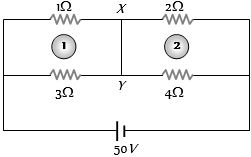
- 9Current through wire $XY$ of circuit shown is ................ $A$View Solution
- 10View SolutionIn the circuit shown in the figure, the current through