MCQ
An electron collides with a fixed hydrogen atom in its ground state. Hydrogen atom gets excited and the colliding electron loses all its kinetic energy. Consequently the hydrogen atom may emit a photon corresponding to the largest wavelength of the Balmer series. The min. $K.E.$ of colliding electron will be.....$eV$
  • A
    $10.2$
  • B
    $1.9 $
  • $12.1$
  • D
    $13.6$

Answer

Correct option: C.
$12.1$
c
Longest wavelength of the Balmer series for a hydrogen atom corresponds to a transition of an electron from $n=3$ Quantum state and $n=2$ quantum level. This means that when the hydrogen Atom was excited by the colliding electron, the electron went from $n=1$ to $n=3$ quantum state.

Energy of $n-n$ Quantum state for a hydrogen atom. $=E_{n}=\frac{m_{e} e^{4}}{8 n^{2} E_{o}^{2} h^{2}}$

Where,

$m_{e}=$ mass of electron.

$e=$ charge of an electron.

$n=$ quantum number(Orbit).

$E_{o}=$ absolute permittivity.

$h=$ Planck's Constant.

By evaluating the constants we get,

$E_{n}=\frac{-13.6}{n^{2}} e V$

$\therefore$ Energy of $n=3$ Quantum state,

$E_{3}=\frac{-13.6}{3^{2}} e V$

$E_{3}=-1.51 e V \longrightarrow(1)$

Energy of $n=1$ Quantum state,

$E_{1}=\frac{-13.6}{1^{2}} e V$

$E_{1}=-13.6 e V \longrightarrow(2)$

since this transition happens at the total Express of the kinetic energy of the colliding electron $K$ is:

$K=E_{3}-E_{1}$

$K=-1.51-(-13.6)$

$K=12.1 e V$
Need a full question paper?

Generate a complete, print-ready paper with questions like this in minutes — across 16+ boards, with answer keys.

Start Generating Free

Similar questions

In an $A.C.$ circuit, $I_{\text {rms }}$ and $I_{0}$ are related as
The work done against gravity in taking $10 \,kg$ mass at $1\,m$ height in 1sec will be....$J$
A parallel beam of light travelling in water (refractive index $= 4/3$) is refracted by a spherical air bubble of radius $2\,cm$ situated in water. Assuming the light rays to be paraxial, the position of the image due to refraction at the first surface is
The ratio of the radius of a planet $‘A’$ to that of planet $‘B’$ is $‘r’$. The ratio of acceleration due to gravity on the planets is $‘x’$. The ratio of the escape velocities from the two planets is
A capacitor has capacitance $5 \mu F$ when it's parallel plates are separated by air medium of thickness $d$. A slab of material of dielectric constant $1.5$ having area equal to that of plates but thickness $\frac{ d }{2}$ is inserted between the plates. Capacitance of the capacitor in the presence of slab will be $..........\mu F$
The electric potential at a point in free space due to charge $Q$ coulomb is  $V=Q$$ \times {10^{11}}\,V$ . The electric field at that point is 
A mark at the bottom of a liquid appears to rise by $0.1 m.$ The depth of the liquid is $1\, m$. The refractive index of the liquid is
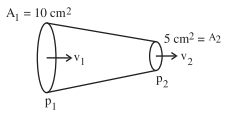
Glycerine of density $1.25 \times 10^3\,kg\,m ^{-3}$ is flowing through the conical section of pipe. The area of cross-section of the pipe at its ends is $10\,cm ^2$ and $5\,cm ^2$ and pressure drop across its length is $3\,Nm ^{-2}$. The rate of flow of glycerine through the pipe is $x \times 10^{-5} m ^3 s ^{-1}$. The value of $x$ is $..............$.
The momentum of a photon of energy $h\nu $ will be
If a satellite orbiting the Earth is 9 times closer to the Earth than the Moon, what is the time period of rotation of the satellite? Given rotational time period of Moon $=27$ days and gravitational attraction between the satellite and the moon is neglected.