MCQ
An electron collides with an atom in its ground state at rest. The atom then emits a photon of energy $E_{photon}$ . In this process the change $\Delta E_{elec}$ in the electron's energy is
  • Greater than $E_{photon}$
  • B
    Greater than or equal to $E_{photon}$
  • C
    Equal to $E_{photon}$
  • D
    Less than or equal to $E_{photon}$

Answer

Correct option: A.
Greater than $E_{photon}$
a
$K_i = K_f + E_{photon} + K_{atom}$

$K_i - K_f = E_{photon} + K_{atom}$

Need a full question paper?

Generate a complete, print-ready paper with questions like this in minutes — across 16+ boards, with answer keys.

Start Generating Free

Similar questions

A wooden block of mass $5 \mathrm{~kg}$ rests on soft horizontal floor. When an iron cylinder of mass $25$ $\mathrm{kg}$ is placed on the top of the block, the floor yields and the block and the cylinder together go down with an acceleration of $0.1 \mathrm{~ms}^{-2}$. The action force of the system on the floor is equal to:
The unit of $e.m.f.$ is
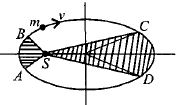
The figure shows elliptical orbit of a planet $m$ about the sun $S.$ The shaded area $SCD$ is twice the shaded area $SAB.$ If $t_1$ is the time for the planet to move from $C$ to $D$ and $t_2$ is the time to move from $A$ to $B$ then
A projectile is thrown from a point $O$ on the ground at an angle $45^{\circ}$ from the vertical and with a speed $5 \sqrt{2} m / s$. The projectile at the highest point of its trajectory splits into two equal parts. One part falls vertically down to the ground, $0.5 s$ after the splitting. The other part, $t$ seconds after the splitting, falls to the ground at a distance $x$ meters from the point $O$. The acceleration due to gravity $g =10 m / s ^2$.

($1$) The value of $t$ is. . . . . . 

($2$) The value of $x$ is. . . . . 

Give the answer or qution ($1$) and ($2$)

A real gas within a closed chamber at $27^{\circ} \mathrm{C}$ undergoes the cyclic process as shown in figure. The gas obeys $P V^3=\mathrm{RT}$ equation for the path $A$ to $B$. The net work done in the complete cycle is (assuming $R=8 \mathrm{~J} / \mathrm{molK}$ ):
An unknown metal of mass $192\, g$ heated to a temperature of $100\,^oC$ was immersed into a brass calorimeter of mass $128\, g$ containing $240\, g$ of water at a temperature of $8.4\,^oC$. Calculate the specific heat of the unknown metal if water temperature stabilizes at $21.5\,^oC$. (Specific heat of brass is $394\, J\, kg^{-1}\, K^{-1}$) ......... $J\, kg^{-1}\, K^{-1}$
In the hydrogen atom, the electron is making $6.6 \times {10^{15}}\,r.p.s.$ If the radius of the orbit is $0.53 \times {10^{ - 10}}\,metre,$ then magnetic field produced at the centre of the orbit is......$Tesla$
The temperature at which the speed of sound in air becomes double of its value at ${0^o}C$ is  ...... $K$
An electron having charge $1.6 \times {10^{ - 19}}\,C$ and mass $9 \times {10^{ - 31}}\,kg$ is moving with $4 \times {10^6}\,m{s^{ - 1}}$ speed in a magnetic field $2 \times {10^{ - 1}}\,tesla$ in a circular orbit. The force acting on electron and the radius of the circular orbit will be
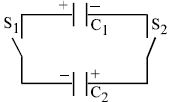
Two capacitors $C_1 = 4\  \mu F$ and $C_2 = 2\ \mu F$ are charged to same potential $ V = 500\  Volt$, but with opposite polarity as shown in the figure. The switches $S_1$ and $S_2$ are closed.