Question
An electron emitted by a heated cathode and accelerated through a potential difference of 2.0 kV, enters a region with uniform magnetic field of 0.15 T. Determine the trajectory of the electron if the field,
  1. is transverse to its initial velocity,
  2. makes an angle of 30º with the initial velocity.

Answer

Magnetic field strength, B = 0.15 T

Charge on the electron, e = 1.6 × 10⁻¹⁹ C

Mass of the electron, m = 9.1 × 10⁻³¹ kg

Potential difference, V = 2.0 kV = 2 × 10³ V

Thus, kinetic energy of the electron = eV

$\Rightarrow\text{eV}=\frac{1}{2}\text{mv}^{2}$

$\text{v}=\sqrt\frac{2\text{ev}}{\text{m}}.........(1)$

Where,

v = velocity of the electron

  1. Magnetic force on the electron provides the required centripetal force of the electron. Hence, the electron traces a circular path of radius r.

Magnetic force on the electron is given by the relation,

$\text{B ev}$

$\text{Centripetal force}=\frac{\text{mv}^{2}}{\text{r}}$

$\therefore\text{Bev}=\frac{\text{mv}^{2}}{\text{r}}$

$\text{r}=\frac{\text{mv}}{\text{Be}}.........(2)$

From equations (1) and (2), we get

$\text{r}=\frac{\text{m}}{\text{Be}}\Big[\frac{2\text{ev}}{\text{m}}\Big]^{\frac{1}{2}}$

$=\frac{9.1\times10^{-31}}{0.15\times1.6\times10^{-19}}\times\Big(\frac{2\times1.6\times10^{-19}\times2\times10^{3}}{9.1\times10^{-31}}\Big)^{\frac{1}{2}}$

$=100.55\times10^{-5}$

$=1.01\times10^{-3}\text{m}$

$=1\text{mm}$

Hence, the electron has a circular trajectory of radius 1.0 mm normal to the magnetic field.

  1. When the field makes an angle θ of 30° with initial velocity, the initial velocity will be,

$\text{v}_{1}=\text{v}\sin\theta$

From equation (2), we can write the expression for new radius as: $\text{r}_{1}=\frac{\text{mv}_{1}}{\text{Be}}$

$=\frac{\text{mv}\sin\theta}{\text{Be}}$

$=\frac{9.1\times10^{-31}}{0.15\times1.6\times10^{-19}}\times\Big(\frac{2\times1.6\times10^{-19}\times2\times10^{3}}{9\times10^{-31}}\Big)^{\frac{1}{2}}\times\sin30^{\circ}$

$=0.5\times10^{-31}\text{m}$

$=0.5\text{mm}$

Hence, the electron has a helical trajectory of radius 0.5 mm along the magnetic field direction. 
Need a full question paper?

Generate a complete, print-ready paper with questions like this in minutes — across 16+ boards, with answer keys.

Start Generating Free

Similar questions

The earth revolves round the sun due to gravitational attraction. Suppose that the sun and the earth are point particles with their existing masses and that Bohr's quantization rule for angular momentum is valid in the case of gravitation. (a) Calculate the minimum radius the earth can have for its orbit. (b) What is the value of the principal quantum number n for the present radius? Mass of the earth = 6.0 × 10⁻²⁴kg. Mass of the sun = 2.0 × 1030kg, earth-sun distance = 1.5 × 10¹¹m.
Give a brief description of the basic elementary process involved in the photoelectric emission in Einstein’s picture.
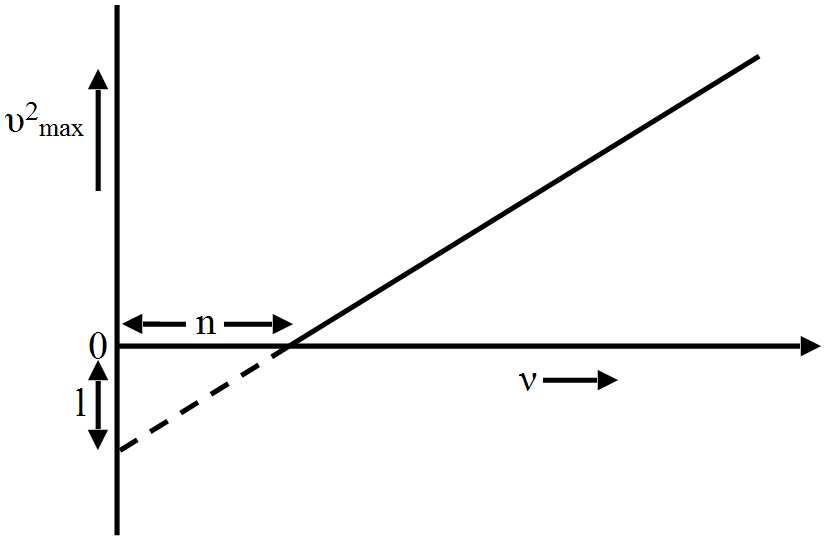
When a photosensitive material is irradiated with the light of frequency v, the maximum speed of electrons is given by vmax. A plot of v2max is found to vary with frequency ν as shown in the figure.

Use Einstein’s photoelectric equation to find the expressions for:
  1. Planck’s constant.
  2. Work function of the given photosensitive material, in terms of the parameters l, n and mass m of the electron.
A disc of radius R is cut out from a larger disc of radius 2R in such a way that the edge of the hole touches the edge of the disc. Locate the centre of mass of the residual disc.
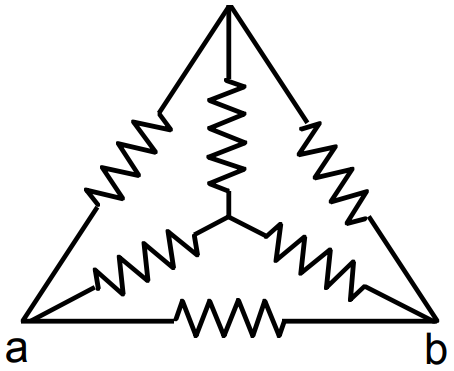
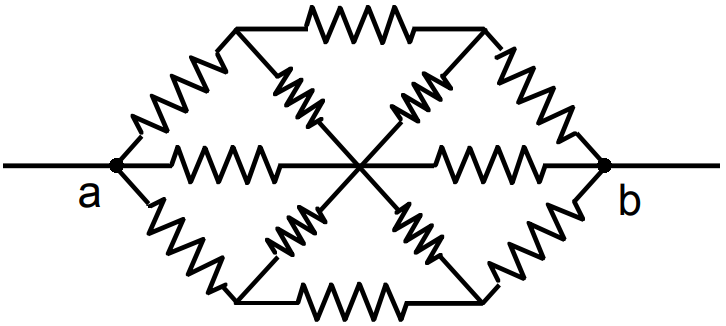
Find the equivalent resistance of the circuits shown in the figure. between the points a and b. Each resistor has resistance r.


There are two sources of light, each emitting with a power of 100W. One emits X-rays of wavelength 1nm and the other visible light at 500nm. Find the ratio of number of photons of X-rays to the photons of visible light of the given wavelength?
In Young’s double-slit experiment using monochromatic light of wavelength λ, the intensity of light at a point on the screen where path difference is λ, is K units. What is the intensity of light at a point where path difference is λ/3?
What is meant by electric potential? Calculate the electric potential generated by a point charge. Draw the equipotential surfaces resulting from this.
Two wires of equal length, one of aluminium and the other of copper have the same resistance. Which of the two wires is lighter? Hence explain why aluminium wires are preferred for overhead power cables.
$(\rho_{\text{A}1}=2.63\times10^{-8}\Omega\ \text{m,}\ \text{Relative density of Al}=2.7,\ \text{of Cu}=8.9)$
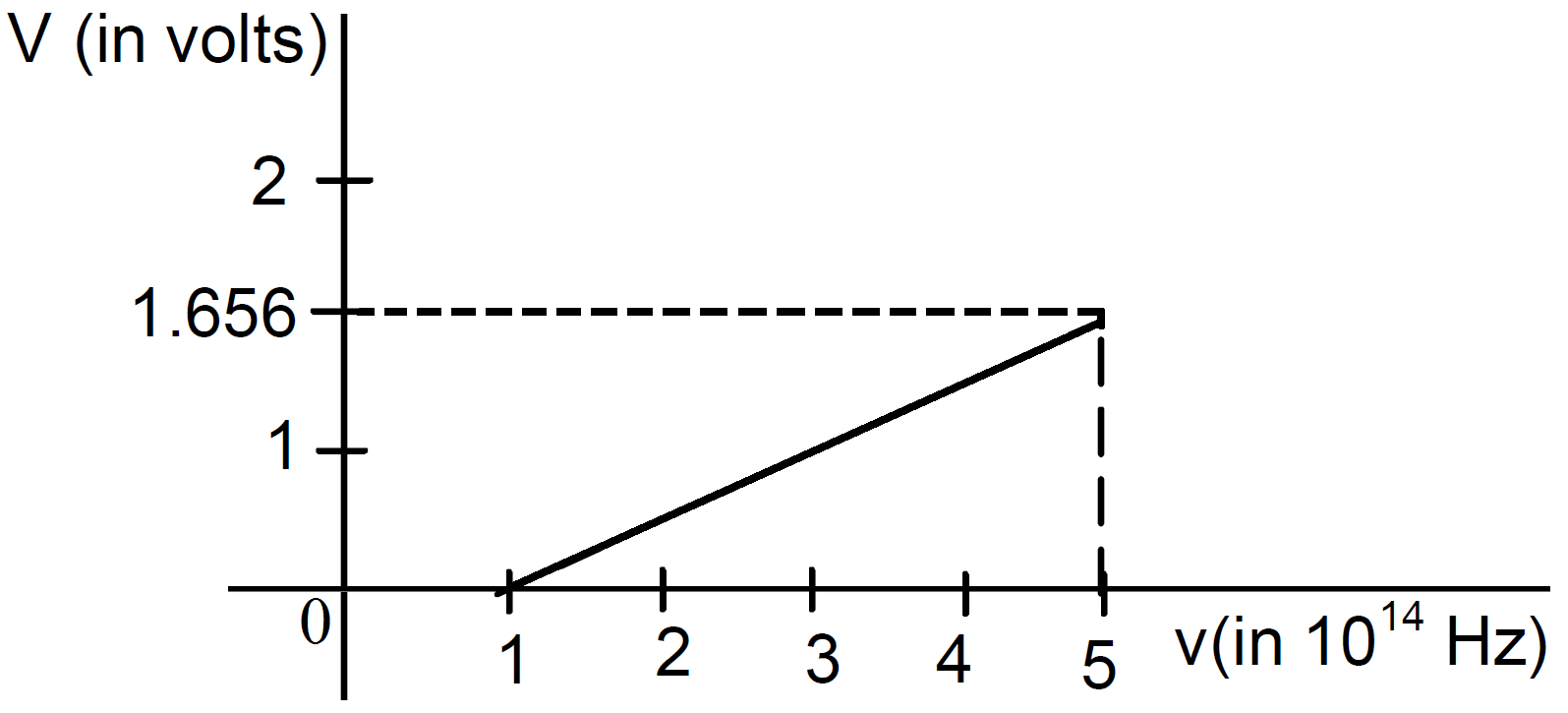
Figure is the plot of the stopping potential versus the frequency of the light used in an experiment on photoelectric effect. Find.

  1. The ratio h/e and.
  2. The work function.

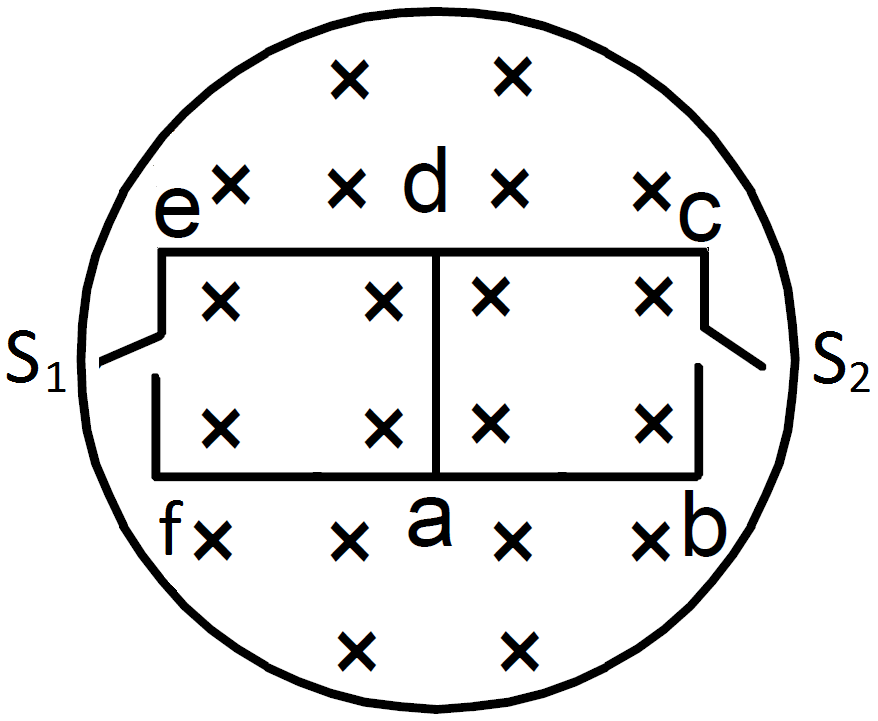
The magnetic field in the cylindrical region shown in figure increases at a constant rate of 20.0mT/s. Each side of the square loop abcd and defa has a length of 1.00cm and a resistance of $4.00\Omega.$ Find the current (magnitude and sense) in the wire ad if:

  1. The switch S1 is closed but S2 is open.
  2. S1 is open but S2 ia closed.
  3. Both S1 and S2 are open.
  4. Both S1 and S2 are closed.