Question
An electron gun emits 2.0 × 10¹⁶ electrons per second. What electric current does this correspond to?

Answer

No. of electrons per second = 2 × 10¹⁶ electrons/ sec.
Charge passing per second $=2\times10^{16}\times1.6\times10^{-9}\frac{\text{coulomb}}{\text{sec}}$
$=3.2\times10^{-9}$ Coulomb/ sec
Current $=3.2\times10^{-3}\text{A}.$

Need a full question paper?

Generate a complete, print-ready paper with questions like this in minutes — across 16+ boards, with answer keys.

Start Generating Free

Similar questions

A person is painting his house walls. He stands on a ladder with a bucket containing paint in one hand and a brush in other. Suddenly the bucket slips from his hand and falls down on the floor. If the bucket with the paint had a mass of 6.0kg and was at a height of 2.0m at the time it slipped, how much gravitational potential energy is lost together with the paint?
Because of the friction between the water in oceans with the earth's surface, the rotational kinetic energy of the earth is continuously decreasing. If the earth's angular speed decreases by 0.0016rad/ day in 100 years, find the average torque of the friction on the earth. Radius of the earth is 6400km and its mass is 6.0 × 1024kg.
What is linear magnification? Obtain equation of linear magnification for mirror.
Write down the equation of displacement current and derive the Ampere-Maxwell's law.
A wire, carrying a current i, is kept in the x−y plane along the curve $\text{y}=\text{A}\sin\Big(\frac{2\pi}{\lambda}\text{x}\Big).$ A magnetic field B exists in the z direction. Find the magnitude of the magnetic force on the portion of the wire between $\text{x}=0$ and $\text{x}=\lambda.$
A plate of thickness t made of a material of refractive index $\mu$ is placed in front of one of the slits in a double slit experiment.
  1. Find the change in the optical path due to introduction of the plate.
  2. What should be the minimum thickness t which will make the intensity at the centre of the fringe pattern zero? Wavelength of the light used is $\lambda$. Neglect any absorption of light in the plate.
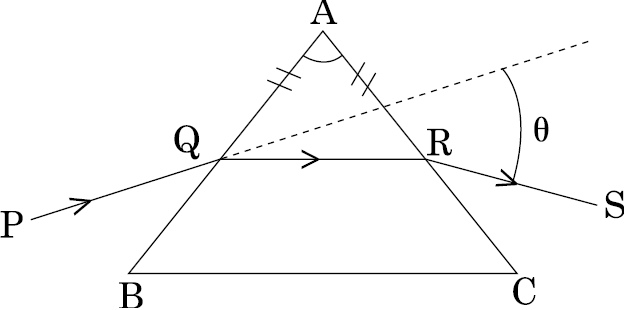
A ray PQ incident on the refracting face BA is refracted in the prism BAC as shown in the figure and emerges from the other refracting face AC as RS such that AQ = AR. If the angle of prism A = 60o and refractive index of material of prism is$\sqrt{3}$, calculate angle $\theta.$

The decay constant of $\text{ }^{197}_{80}\text{Hg}$ (electron capture to $\text{ }^{197}_{79}\text{Au}$) is 1.8 × 10⁻⁴ S-1.
  1. What is the half-life?
  2. What is the average-life?
  3. How much time will it take to convert 25% of this isotope of mercury into gold?
Answer the following question:
In viewing through a magnifying glass, one usually positions one’s eyes very close to the lens. Does angular magnification change if the eye is moved back?
Three sources of sound S1, S2 and S3 of equal intensity are placed in a straight line with S1S2 = S2S3 figure. At a point P, far away from the sources, the wave coming from S is 120° ahead in phase of that from S1. Also, the wave coming from S3 is 120° ahead of that from S2. What would be the resultant intensity of sound at P?