Question

An electron is moving along positive x-axis. To get it moving on an anticlockwise circular path in x-y plane, a magnetic filed is applied

(a) Along positive y-axis

(b) Along positive z-axis

(c) Along negative y-axis

(d) Along negative z-axis

Answer

(b) Along positive z-axis

Need a full question paper?

Generate a complete, print-ready paper with questions like this in minutes — across 16+ boards, with answer keys.

Start Generating Free

Similar questions

What is the order of potential difference built up by the Van de Graff generator?

Assertion  :  A person touching a high power line gets stuck with the line.

Reason     : The current carrying wires attract the man towards it.

(a) If both assertion and reason are true and the reason is the correct explanation of the assertion.

(b) If both assertion and reason are true but reason is not the correct explanation of the assertion.

(c) If assertion is true but reason is false.

(d) If the assertion and reason both are false.

How will  the force between the two poles change if the two poles are connected by an iron rod keeping the distance between two magnetic poles constant ?
A dielectric slab is inserted between the plates of an isolated capacitor. The force between the plates will:
  1. Increase.
  2. Decrease.
  3. Remain unchanged.
  4. Become zero.
An electric current i enters and leaves a uniform circular wire of radius a through diametrically opposite points. A charged particle q moving along the axis of the circular wire passes through its centre at speed v. The magnetic force acting on the particle when it passes through the centre has a magnitude:
The difference between the mass of a nucleus and the total mass of the constituents is its.

When we touch the terminals of a high voltage capacitor, even after a high voltage has been cut off, then the capacitor has a tendency to

(a) Restore energy

(b) Discharge energy

(c) Affect dangerously

(d) Both (b) and (c)

 A normal eye is not able to see objects closer than 25cm because:
  1. The focal length of the eye is 25cm.
  2. The distance of the retina from the eye-lens is 25cm.
  3. The eye is not able to decrease the distance between the eye-lens and the retina beyond a limit.
  4. The eye is not able to decrease the focal length beyond a limit.

If the separation between slits in Young’s double slit experiment is reduced to   the fringe width becomes n times. The value of n is

(a) 3 

(b)  

(c) 9  

(d)  

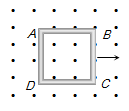
A metallic square loop ABCD is moving in its own plane with velocity v in a uniform magnetic field perpendicular to its plane as shown in the figure. An electric field is induced

(a) In AD, but not in BC

(b) In BC, but not in AD

(c) Neither in AD nor in BC

(d) In both AD and BC