MCQ
An electron is moving in the north direction. It experiences a force in vertically upward direction. The magnetic field at the position of the electron is in the direction of
  • East
  • B
    West
  • C
    North
  • D
    South

Answer

Correct option: A.
East
a
(a)By Fleming left hand rule.

Need a full question paper?

Generate a complete, print-ready paper with questions like this in minutes — across 16+ boards, with answer keys.
Start Generating Free

Similar questions

In an adiabatic process, which of the following statements is true?
$A$ particle of mass $2\, kg$ located at the position $(\hat i + \hat j)$ $m$ has a velocity $2( + \hat i - \hat j + \hat k)m/s$. Its angular momentum about $z$ -axis in $kg-m^2/s$ is
A ball suspended by a thread swings in a vertical plane so that its magnitude of acceleration in the extreme position and lowest position are equal. The angle $(\theta)$ of thread deflection in the extreme position will be :
Light from a point source in air falls on a convex curved surface of radius $20 \mathrm{~cm}$ and refractive index $1.5.$ If the source is located at $100 \mathrm{~cm}$ from the convex surface, the image will be formed at $\mathrm{cm}$ from the object.
What is the voltage gain in a common emitter amplifier, where input resistance is $3\, \Omega$ and load resistance $24\, \Omega, \beta=0.6 \,?$
An $e.m.f$ of $15$ $volt$ is applied in a circuit containing $5$ henry inductance and $10$ $ohm$ resistance. The ratio of the currents at time $t = \infty $ and at $t = 1$ $second$ is
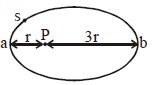
A satellite $S$ moves around a planet $P$ in an elliptical orbit as shown in figure. The ratio the speed of the satellite at point $a$ to that at point $b$ is
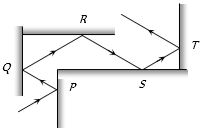
Following figure shows the multiple reflections of a light ray along a glass corridor where the walls are either parallel or perpendicular to one another. If the angle of incidence at point $P$ is $30^o $, what are the angles of reflection of the light ray at points $Q, R, S$ and $T$ respectively
In a mechanical refrigerator, the low temperature coils are at a temperature of $-23°C$ and the compressed gas in the condenser has a temperature of $27°C.$ The theoretical coefficient of performance is
The angular velocities of three bodies in simple harmonic motion are ${\omega _1},\,{\omega _2},\,{\omega _3}$ with their respective amplitudes as ${A_1},\,{A_2},\,{A_3}$. If all the three bodies have same mass and velocity, then