Question
An electron is not deflected while passing through any field. Is it possible that there is no magnetic field present at that place? Explain.

Answer

Exerting force in magnetic field on a moving electron with velocity $\vec{v}$
$\overrightarrow{ F }=-e(\vec{v} \times \overrightarrow{ B })$
or $\overrightarrow{ F }=-e v B \sin \theta$
If $\theta=0^{\circ}$ or $180^{\circ}$, the magnitude of force F will be zero. Hence, an electron will not be deflected if it moves parallel or opposite to the direction. So, we cannot say that magnetic field is absent.

Need a full question paper?

Generate a complete, print-ready paper with questions like this in minutes — across 16+ boards, with answer keys.

Start Generating Free

Similar questions

State Biot-Savart law.

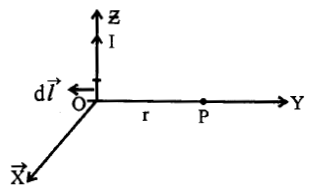
A current I flows in a conductor placed perpendicular to the plane of the paper.Indicate the direction of the magnetic field due to a small element d $\overrightarrow{l}$at point P situated at a  distance $ \overrightarrow{r}$ from the element as shown in the figure.

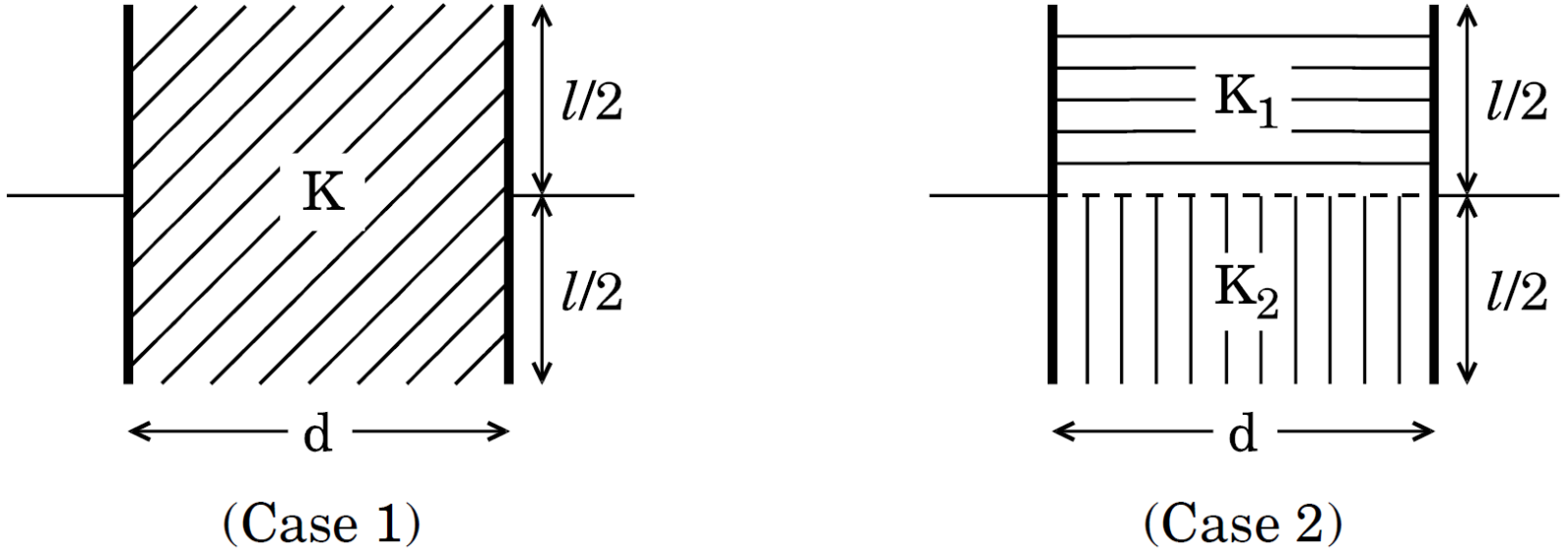
The space between the plates of a parallel plate capacitor is completely filled in two ways. In the first case, it is filled with a slab of dielectric constant K. In the second case, it is filled with two slabs of equal thickness and dielectric constants K1 and K2 respectively as shown in the figure. The capacitance of the capacitor is same in the two cases. Obtain the relationship between K, K1 and K2.

The dielectric strength of air is 3.0 × 10⁶V/m. A parallel-plate air-capacitor has area 20cm2 and plate separation 0.10mm. Find the maximum rms voltage of an AC source that can be safely connected to this capacitor.
Explain current sensitivity and voltage sensitivity of galvanometer.
Is it necessary to have two waves of equal intensity to study interference pattern? Will there be an effect on clarity if the waves have unequal intensity?
Explain how does the polarized dielectric modify the original external field inside it ?
You are given a low resistance $R_1$, a high resistance $R_2$ and a galvanometer. How will you make such instruments from them which can measure (i) current, (ii) potential difference?
Light of wavelength 560nm goes through a pinhole of diameter 0.20mm and falls on a wall at a distance of 2.00m. What will be the radius of the central bright spot formed on the wall?
a. Show that the time period (T) of oscillations of a freely suspended magnetic dipole of magnetic moment (m) in a uniform magnetic field (B) is given by $T=2 \pi \sqrt{\frac{I}{m B}}$, where I is a moment of inertia of the magnetic dipole.
b. Identify the following magnetic materials:
i. A material having susceptibility $\left(\chi_m\right)=-0.00015$.
ii. A material having susceptibility $\left(\chi_m\right)=10^{-5}$.
The mass of cyclist together with the bike is 90kg. Calculate the increase in kinetic energy if the speed increases from 6.0km/h to 12km/h.