MCQ
An electron oscillating with a frequency of 3 × 10⁶ Hz, would generate:
  • A
     X-rays
  • B
    Ultraviolet rays
  • C
    Radio waves
  • D
    Microwaves

Answer

  1. Radio waves

Need a full question paper?

Generate a complete, print-ready paper with questions like this in minutes — across 16+ boards, with answer keys.

Start Generating Free

Similar questions

The imaginary line passing through the pole and the center of curvature of the curved mirror is called its _______.

Heat produced in a wire of resistance R due to current flowing at constant potential difference is proportional to

(a)  

(b)  

(c) R 

(d)  

A beam of light of wavelength 600 nm from a distant source falls on a single slit 1 mm wide and the resulting diffraction pattern is observed on a screen 2 m away. The distance between the first dark fringes on either side of the central bright fringe is

(a) 1.2 mm

(b) 1.2 cm

(c) 2.4 cm

(d) 2.4 mm

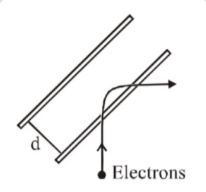
A problem of practical interest is to make a beam of electrons turn at 90° corner. This can be done with the parallel plates shown in figure. An electron with kinetic energy 8.0 × 10⁻¹⁷J enters through a small hole in the bottom plate. The strength of electric field that is needed if the electron is to emerge from an exit hole 1.0cm away from the entrance hole, traveling at right angles to its original direction is _______ ×105N/ C.

In a sensitive Wheatstone bridge, current in the galvanometer in the state of slight deflection from the position of balance is:
The electrical conductivity of pure germanium can be increased by:
If the corrent constant for a transistor are $ \alpha $ & $ \beta $, then :
The value of current obtained in a moving coil galvanometer is proportional to :

Magnetic dipole moment is a

(a) Scalar quantity

(b) Vector quantity

(c) Constant quantity

(d) None of these

Which magnetic materials have negative susceptibility?