Question
An electron with initial kinetic energy of $100 \,\,eV$ is acceleration through a potential difference of $50\, V$. Now the de-Broglie wavelength of electron becomes .................. $\mathop {\rm{A}}\limits^o $

Answer

Additional kinetic energy it gains is

$K^{\prime}=e V=50 \quad e V$

Total kinetic energy is equal to $150 \times 1.6 \times 10^{-19} J$

The de broglie wavelength is $\lambda=\frac{h}{\sqrt{2 m K}}=\frac{6.63 \times 10^{-34}}{\sqrt{2 \times 9.1 \times 10^{-34} \times 150 \times 1.6 \times 10^{-19}}}=1 \times 10^{-10} \mathrm{m}$

$\lambda=1 A^{o}$

Need a full question paper?

Generate a complete, print-ready paper with questions like this in minutes — across 16+ boards, with answer keys.
Start Generating Free

Similar questions

The two interfering waves have intensities in the ratio $9 : 4$. The ratio of intensities of maxima and minima in the interference pattern will be
A frictionless pulley is attached to one arm of a balance and a string passed around it carries two masses $m_1$ and $m_2$. The pulley is provided with $a$ clamp due to which $m_1$ and $m_2$ do not move $w.r.t.$ each other. On removing the clamp, if the counter mass restores balance, then acceleration of centre of mass of the masses $m_1$ and $m_2$ will have acceleration of magnitude ? 
If a calculated value $2.7465 \,g$ contains only three significant figures, the two insignificant digits in it are ............ 
Assume that an electric field $\overrightarrow E  = 30{x^2}\hat i$ exists in space. Then the potential difference $V_A -V_O$, where $V_O$ is the potential at the origin and $V_A$ the potential at $x = 2\, m$ is
A flint glass prism and a crown glass prism are to be combined in such a way that the deviation of the mean ray is zero. The refractive index of flint and crown glasses for the mean ray are $1.620$ and $1.518$  respectively. If the refracting angle of the flint prism is $6.0^o$ , what would be the refracting angle of the crown prism?.....$^o$
Two particles of mass $5\, kg$ and $10\, kg$ respectively are attached to the two ends of a rigid rod of length $1\, m$ with negligible mass. The centre of mass of the system from the $5\, kg$ particle is nearly at a distance of $..........\, cm$
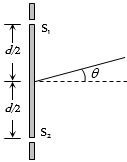
In an interference arrangement similar to Young's double slit experiment, the slits $S_1$ and $S_2$ are illuminated with coherent microwave sources each of frequency $10^6 Hz$. The sources are synchronized to have zero phase difference. The slits are separated by distance $d = 150\, m$. The intensity I$(\theta )$is measured as a function of $\theta$, where $\theta$ is defined as shown. If $I_0$ is maximum intensity, then $I(\theta )$ for $0 \le \theta \le {90^o}$is given by
The motion of a particle varies with time according to the relation $y = a(\sin \omega \,t + \cos \omega \,t)$, then
At constant volume, temperature is increased. Then
A graph of the square of the velocity against the square of the acceleration of a given simple harmonic motion is