MCQ
An element has electronic configuration $1{s^2}2{s^2}2{p^6}3{s^2}3{p^4}$. Predict their period, group and block
  • Period = $3^{rd}$, block = $p$, group = $16$
  • B
    Period =$ 5^{th}$, block = $s$, group = $1$
  • C
    Period = $3^{rd}$, block =$ p$, group = $10$
  • D
    Period = $4^{th}$, block = $d$, group = $12$

Answer

Correct option: A.
Period = $3^{rd}$, block = $p$, group = $16$
a
$(a)$ By obserbing principal quantum number $(n)$, Orbital $(s,p,d,f)$ and equating no. of ${e^ - }$’s we are able to find the period, block and group of element in periodic table.

Need a full question paper?

Generate a complete, print-ready paper with questions like this in minutes — across 16+ boards, with answer keys.

Start Generating Free

Similar questions

One litre of a buffer solution containing 0.01M NH4Cl and 0.1M NH4OH having pKb of 5 has pH of:
$A + 2B + 3C \rightleftharpoons A{B_2}{C_3}$ Reaction of $6.0\, g$ of $A$, $6.0\times10^{23}$ atoms of $B$, and $0.036\, mol$ of $C$ yields $4.8\, g$ of compound $AB_2C_3$ . If the atomic mass of $A$ and $C$ are $60$ and $80\, amu$, respectively, the atomic mass of $B$ is .............. $\mathrm{amu}$ (Avogadro no . $= 6 \times10^{23}$)
Which compound is $Z$ but not cis
The reaction $A(g) + 2B(g) \longrightarrow C(g) + D(g)$ is an elementary process. In an experiment, the initial partial pressure of $A$ and $B$ are $0.6$ and $0.8\, atm$, respectively. When partial pressure of $C$ is $0.2\, atm$, the rate of reaction relative to the initial rate is
The correct order of electronegativity of Na, O and F is:
Identify the pairs which are not of isotopes?
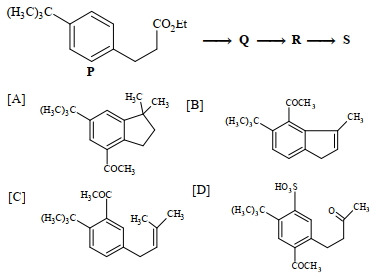
The reaction of compound $\mathbf{P}$ with $CH_3 MgBr$ (excess) in $\left(C_2 \mathrm{H}_5\right)_2 O$ followed by addition of $H_2 O$ gives $Q$. The compound $Q$ on treatment with $H_2 SO_4$ at $0^{\circ} C$ gives $R$. The reaction of $R$ with $CH_3 COC1$ in the presence of anhydrous $AlCl_3$ in $CH_2 Cl_2$ followed by treatment with $H_2 O$ produces compound $S$ [ $Et$ in compound $P$ is ethyl group]

(image)

($1$) The product $S$ is

(image)

($2$) The reactions, $Q$ to $R$ and $R$ to $S$, are

$[A]$ Dehydration and Friedel-Crafts acylation

$[B]$ Aromatic sulfonation and Friedel-Crafts acylation

$[C]$ Friedel-Crafts alkylation, dehydration and Friedel-Crafts acylation

$[D]$ Friedel-Crafts alkylation and Friedel-Crafts acylation

Given the answer quetion ($1$) and ($2$)
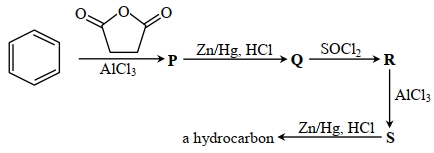
Considering the following reaction sequence, the correct statement(s) is(are)

$(A)$ Compounds $P$ and $Q$ are carboxylic acids.

$(B)$ Compound $S$ decolorizes bromine water.

$(C)$ Compounds $P$ and $S$ react with hydroxylamine to give the corresponding oximes.

$(D)$ Compound $R$ reacts with dialkylcadmium to give the corresponding tertiary alcohol.

Which reaction has positive value of $\Delta G^o$ ?
What volume of oxygen gas $(O_2)$ measured at $0\,^o C$ and $1\ atm,$ is needed to burn completely $1\ L$ of propane gas $(C_3H_8)$ measured under the same conditions? .......... $\mathrm{L}$